Short interactive retrospective
From 1996 to 1999, I participated in the experimentation and production of interactive documentary works at Interval Research Corporation, a laboratory and technology incubator in Palo Alto, California. At this stage of my research, almost twenty years later, as the technological context has changed and I am reflecting on this mode of documentary representation, a brief review of several important communicative intentions from this experimental period appears useful for the progress of my reflection. Furthermore, these collaborations strongly influenced my current desire to explore the interactive documentary, and the quality of the works produced and the collaborators of that time still inspire me today in my approach as a researcher and creator.
For three years, I collaborated on various forms of interactive documentary, discursive, and reflexive devices. My primary collaborators were Michael Naimark and Rachel Strickland. For over 30 years, Michael Naimark has explored various devices for the capture, representation, and virtual experimentation of real spaces and environments using new media and immersive installations. Architect and documentarian Rachel Strickland is interested in the various portable systems that people deploy to carry the personal belongings they need for daily life. At the time, Rachel Strickland was building a database of navigable and interactive information, images, and video portraits.
3.1 *Be Now Here* (1995)
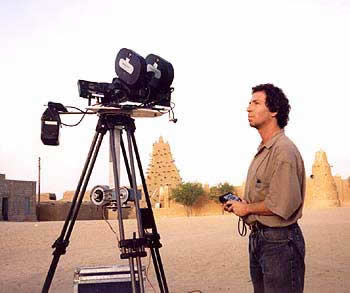
I collaborated several times with Michael Naimark on different space-capture projects while I was working at the Banff Centre for the Arts and Interval Research Corporation. I am interested here in *Be Now Here* (1995), an immersive installation constructed from 3-D stereoscopic film documentation of four sites on the UNESCO List of World Heritage in Danger: Jerusalem, Dubrovnik, Timbuktu, and Angkor in Cambodia. These are historical sites that have been differently compromised over the last century by war and conflict and which bear their scars. For instance, the monuments of Dubrovnik are marked by bullet and mortar traces, the Wailing Wall in Jerusalem is controlled by the military, etc. I assisted Naimark for the shoot in Timbuktu and was present during the preparations for the work’s first presentation in San Francisco.
Figure 5: Michael Naimark in Timbuktu for the filming of *Be Now Here*.
(photo: Gilles Tassé)
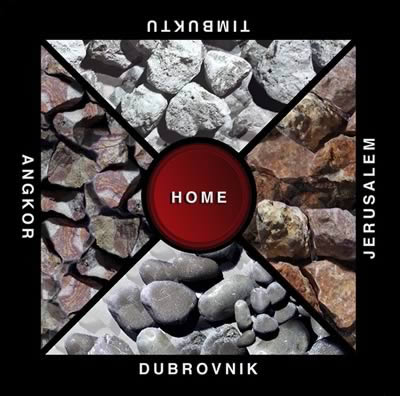
Each heritage site was filmed at sunrise, sunset, and in the afternoon from a unique viewpoint, one that best captured the physical and historical characteristics of the location, as well as the human activity taking place there. During the experience, visitors to the installation wear 3-D glasses and, by means of a physical interface device, choose the location they wish to see and thus visit. When a visitor presses the name of one of the four cities appearing on the interface, the projection screen shows the new location at the same time of day as the one it succeeds. If no action is taken by a viewer and no voluntary change of location is made, the system presents all segments of the same location one by one, then proceeds to the next location. When a visitor presses the HOME button, the projector shuts off for a few seconds, the intensity of the lights in the presentation room increases slightly, and each visitor has the opportunity to notice the presence of other visitors, as well as their actual location of active presence: the exhibition room.
Figure 6: Physical interface of *Be Now Here*.
The names and the rocks are the push-buttons allowing the choice of the virtual visit site.
Online. http://www.naimark.net/projects/benowhere/benowhere_i3.html. Accessed April 25, 2015.
This interactive and immersive device thus offers visitors the possibility to conceptually parallel sites that, although foreign to one another, all possess heritage value made fragile by conflict or war. The visual and immersive juxtaposition of different locations prompts a reflection that highlights the element of human responsibility in the degradation or disappearance of these unique places. Furthermore, the device’s HOME function places the visitor in a situation of personal questioning and accountability regarding the issues presented.
This project appears to me to possess a particularly effective interface due to its simplicity in communicating the choices offered to the visitor and in clearly and directly responding to the interactive gestures they are led to perform. Moreover, the interactive limitations of the device—five interaction possibilities—promote clear and simple communication, making it easy to master. This allows the visitor to more easily experience the sense of immersion offered by the device, to better feel the evocative emotion of the locations, and to continue their reflection. These are qualities of communication and interaction that I will attempt to promote in the development of my own interactive documentary object and in the design of its interface.
3.2 *Portable Portraits* (1989-1998)
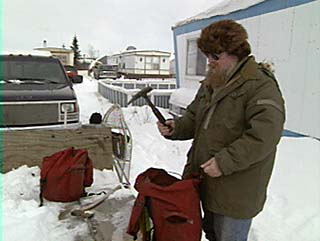
Rachel Strickland’s *Portable Portraits* (1989-1998) is the project I collaborated on most extensively during my time at the Palo Alto think tank. It consists of a series of documentaries focusing on a variety of people of all ages and backgrounds and their daily portable systems: backpacks, jacket pockets, briefcases, etc. The video segments are designed to be both navigable toward similar videos and "viewable" independently.
Figure 7: Walter Humphries, gold prospector, at Yellowknife, April 1997. Online.
http://www.portablefx.com/system/portraits/WalterHumphries.jpg. Accessed April 23, 2015. (video thumbnail, camera: Gilles Tassé)
As an editor, I had to ensure narrative and visual coherence for the documentary segment in its linear progression while making its possible abandonment toward other segments of similar content as fluid as possible at specific, pre-established moments. The entry and exit points of the various video segments had to be established to maximize the fluidity of the match cut, while allowing for the optimal completion of the segment currently being viewed. It should be noted that at the time, the technical means for interactivity and viewing did not yet permit the creation of a truly functional platform.
Figure 8: A continuous media flow showing; (0) a passive jump;
invisible extension; (2) premature contraction. (Freeman 2000, p. 5).
Considerable time and effort were invested in constructing a semblance of narrative linearity during the development of this interactive prototype. Among other tasks, numerous hours were devoted to subtracting or re-adding a few frames to the hundreds of video portraits in order to make the transition between different segments as fluid as possible during hypothetical exits from the current linear narrative progression. This focus on maintaining narrative fluidity following a spectator's interaction illustrates a certain conception of interactivity that now appears to me less necessary, if not less effective.
3.3 Device of Interaction and Reflection
Today, following the reflection underway in this thesis, it seems to me that this global, networked, and digital society (Daly 2010, p. 83) calls more for an interactive documentary cinema that highlights the exits from narrative progression made by the spect-actor. Indeed, the spectator's actualization of their desire to know more—which is achieved through some actantial gesture—first requires from them a clear will to understand and a desire to make the decision to act to achieve it. These are qualities of presence that are not dependent on the fluidity of narrative immersion or passive identification with a character. We must consider the interactivity of this new cinema as a device for accountability and engagement for the user, allowing them to validate both their presence and their actions throughout their journey.
I submit, therefore, that the presence of audiovisual indications—whether interfacial or filmic—during clearly assumed moments of diversion from the linear necessarily corresponds to the voluntary moments of meaning-connection that the spectator is performing. This quality of experimentation and interaction allows the user both to anticipate and to immediately perceive the consequences of their gesture. Thus, it is possible for them to fully grasp the impact of their active presence within the enunciating device and to assume responsibility for the progress of their reflection. And as I emphasized in the second chapter, the new user of communication devices is entirely ready to take and assume these opportunities for diversion offered to them—opportunities which, according to my expertise, can direct them even further into the reflection I offer them.
The memory of this desire for fluid narrative expansion and the reflection it provokes at this point in my research reveal a certain rigidity of the linear that I have always assumed and taken for granted, without, however, being fully aware of it. It seems important to highlight this new approach I have toward interactivity, as I still recently intended to give the most fluid form possible to my offerings of interaction and navigation of documentary content. Indeed, it was only during the writing of this short chapter, while I was still immersed in the reflections of the previous chapter, that I suddenly understood this change in my perception of interactivity.
3.4 Navigation and reflection by icons
Conversely, an element of the interface prototype designed for *Portable Portraits* still seems innovative and relevant today in the development of my own interactive documentary object. In summary, the documentary content of the various videoclips forming *Portable Portraits* was analyzed and categorized using an icon-based identification system, established according to data collected concerning the different portable systems documented. These icons, representing categories of subject, verb, or complement, allowed for an identification and classification of the informational nature of the audiovisual material during viewing; for example, woman – briefcase – work, or man – backpack – food, etc. This categorization of informational content was established to subsequently allow for the creation of links with certain sequences present in other video segments, much like keywords during an Internet search. During a future viewing and a probable interactive experimentation (following the prototype's planned evolution at the time), icons were intended to appear on the screen to inform the spectator-navigator of the existence of sequences that might interest them because they were related to various themes present in their current viewing. By clicking on one of the thematic link icons, the spectator chose to undergo a narrative diversion and engaged voluntarily and more deeply in their ongoing reflection. They chose the theme, duration, and direction of their reflection, even if it meant changing their mind later and pursuing another direction. They controlled the narrative flow of the device and directed the progression of their reflection.
I retain here the capacity of this interface to identify the quality of the informational content during viewing and to offer the possibility of navigating it based on the participation and reflection criteria of the moment. Furthermore, this interactive device allows the spectator to quickly understand where they are and where they might also be interested in going. It is an interface that thus participates in the active reflection concerning the content currently unfolding and that which is potentially to come; and which is therefore of navigational, narrative, and cognitive utility all at once. Let us return to this approach that once occupied me in order to highlight two things that seem particularly important today in the development of an interactive documentary work: the necessity of breaking free from the weight of linear narrative heritage and the importance of a clear informational navigation interface that participates in the ongoing reflection. This is an observation on the necessity of the spectator's reflective engagement that Kristen Daly shares, though for different reasons.
According to Daly, the boundary between the various aspects of our lives—work, entertainment, communication, information, etc.—is no longer as well-defined as it was in the still-recent era when the tools necessary for their accomplishment were all distinct. Today, this flexible or porous boundary between these different types of activities using the same devices—phone, tablet, computer, etc.—means that the separation between creator and spectator is no longer so clearly defined. This distinction of activity is established variably through the objective and quality of the media interaction at hand. An interaction that becomes, in fact, reflective because it has a changing and adaptable intentionality depending on the moment:
Increasingly, for computer and mobile users, existence is in some intermedial zone of work and leisure; the experience of moving images through computer and digital technologies is interactive, blurring the lines between producer and consumer, spectacle and spectator, representation and information, as embodied by mashups and crowdsourcing. To represent these new sets of relations between art, culture, work, and relations of power, Cinema 3.0 must move beyond vision to engage thought. (Daly 2010, p. 86)
I draw upon the reflection carried out in the first three chapters to develop the formatting of my interactive documentary object and to construct its offer of reflexive engagement which will, I hope, allow for a relationship with the spectator that goes *beyond vision*. The next chapter reports on this process of design, creation, and communication carried out in two distinct stages: a first stage of producing media assets (originally of linear formal intention); then their contribution to the development of my interactive documentary. It is written with the same concern for understanding how the web-documentary can be a tool for reflection on reality and how I can contribute to it.