Du Linéaire
Stellaire
a device for reflection and communication regarding reality
Table des matières
- Abstract
- Abstract
- Acknowledgments
- IntroductionA new formalization of the documentarian's intentions
- Ch. 1A brief creation-based analysis of linear works
- Ch. 2New apparatuses – new users – new objects
- Ch. 3Short interactive retrospective
- Ch. 4Autopoietic interactive creation
- ConclusionReflections of a documentary filmmaker creating an interactive work
- Bibliography
- Filmography
- List of Figures
- List of Abbreviations
Les numéros de page définitifs apparaîtront dans le PDF exporté.
Abstract
This research-creation thesis examines the role of the filmmaker in the formatting of interactive documentaries broadcast on the Web. The author begins by referring to his own conventional documentaries in order to define their primary enunciative objective. Then, he observes the new positions of spectatorship fostered by current media distribution systems to understand the form to be given to the interactive work he is producing and to judge the possibility of embedding his habitual communicative intentions within it. The author subsequently refers to the interactive documentaries in which he participated during the 1990s and determines the interaction devices allowing for an active presence of the spectator. Finally, the author explains the production stages of his web documentary and highlights the research elements that guided its creation. The author concludes with several reflections concerning the relationship existing between the creator of an interactive documentary work and the current multitasking *spect-actor*.
Keywords: Documentary, interactivity, Internet, web documentary, spectatorship, non-linear, author, spect-actor, editing, reflection.
Abstract
This research-creation thesis examines the filmmaker’s role in the production of interactive web documentaries. First, the author recalls conventional documentaries he directed in order to identify their primary discursive objectives. Then, he examines the new spectatorship being defined by current media delivery devices to better understand the shape to be given to the interactive work he is producing and to assess its capacity to carry his usual communication objectives. Subsequently, the author refers to interactive documentaries in which he participated in the 1990s and points out specific interactive devices that proved efficient in accounting for the active presence of the viewer. Finally, the author describes the making of his web documentary and highlights aspects of his research that guided its production. The author concludes with some remarks regarding his creative process and the relationship existing between the filmmaker-creator of an interactive documentary and today’s new multitask *spect-actor*.
Keywords: Documentary, interactivity, Internet, web documentary, spectatorship, non-linear, author, spect-actor, editing, reflection.
Acknowledgments
A first word of thanks to my thesis supervisors, Élène Tremblay and Dominic Arsenault. Through their encouragement and high standards, they enabled me to achieve the level of quality necessary for the proper progression of my reflection.
Thank you also to the Department of Art History and Film Studies and to my professors and classmates. All have contributed to making my academic path both stimulating and respectful. I am very grateful to them for having been able to work and think in such good company.
Special thanks to my collaborators at the Banff Centre for the Arts and Interval Research Corporation, particularly Michael Naimark and Rachel Strickland, with whom I was able to experiment with this interactive documentary form over twenty years ago. They allowed me to initiate a line of inquiry that I am still pursuing today.
Thanks to my friends in Banff, Yellowknife, Vancouver, San Francisco, Los Angeles, Marseille, Paris, Iqaluit, and Montreal with whom I have worked and, just as often, celebrated. They are precious to me and I think of them often.
Thank you to my family for their love and support. I have been a brother and a son who was often absent for long and frequent periods of time. They have always supported me in the realization of my projects.
An immense thank you to my friend John Turkel, who passed away as we were beginning the production of the film *Texan Eels on Wheels*. It was through him that I became interested in the subject of my interactive project, and it is thanks to his generosity that I was able to dedicate these past two years to my studies and complete my master's degree.
And finally, a last thank you to my proofreader Pierre-Yves Marcoux, always efficient, meticulous, and available. And to Sébastien Lévesque, a neighbor from the COOP and an attentive, precise reader, for his judicious last-minute remarks.
A new formalization of the documentarian's intentions
A new audiovisual object, the interactive documentary has been increasingly available on the Internet for several years. A few major producers already stand out, such as the National Film Board and the channel ARTE, which offer a catalogue of several hundred varied and large-scale works on their web portals. Furthermore, a significant portion of so-called traditional media—newspapers, TV and radio stations—offer interactive documentary multimedia experiences to varying degrees on their websites. For example, the public television news channel BBC News offers hyperlinks to video capsules, photos, and analytical texts, and personalizes its web information offering based on the viewing device. The newspaper La Presse has launched an interactive and multimedia version of its newspaper through which readers can navigate information in different media forms as they wish. Similarly, the website of the NPR broadcasting network in the U.S. offers audio and video clips of interviews and documentaries—as broadcast or in their entirety—sometimes accompanied by an analytical text, as well as participatory blogs for registered internet users.
Faced with these new distribution platforms and this new field of expression, it seems necessary and consistent, as a documentarian, to understand how these new interactive documentary apparatuses take shape through their experimentation. Furthermore, I believe it is necessary to first examine the new relationship that exists between media users and these documentary objects that they consume in different forms and with which they interact, before undertaking the production of my web documentary. Thus, I will be able to determine how I must adapt my linear creation approach and better define my contribution as a specialist in the genre when I engage in the production of an interactive documentary form.
From the beginning of my exploration of this audiovisual object, it appeared necessary to invest myself in the production of an interactive documentary in order to stimulate my reflection and illustrate some of my conclusions. Research and creation: two approaches that, sometimes retroactively, sometimes prospectively, fed into one another throughout the production of this thesis. I analyze the creation aspect of my approach in more detail in the autopoietic section of this thesis, where I describe certain particularly revealing moments in the process of creating the interactive object. My final objective is to participate in a better understanding of this new form of documentary and, ultimately, to collaborate in engaging with it in the most effective, informed, and coherent way possible.
For Arnau Gifreu, the existence of this new interactive apparatus is largely due to the complementarity existing between multimedia and the documentary; one possessing great capacities for navigation and interactivity, the other allowing multiple representations of reality:
In some ways, a fusion begins from mutual attraction: the documentary genre contributes with its several modes of representing reality, and the digital media genre contributes with its new navigating and interacting modes. (Gifreu 2011, p. 354)
Arnau Gifreu emphasizes that recent technological and structural evolutions of the Internet now make possible a quality of web navigation that was unthinkable until recently. According to him, these new capacities for content access and interaction have allowed for the emergence of this new genre combining, on one hand, the audiovisual aspect of the documentary and the interactivity of interactive media, and on the other, information content and the ludic navigability of the interactive interface.
There are obvious formal differences between a documentary object with a planned linear progression and one offered in interactive mode (duration, the active role of the spectator, narrative segmentation, etc.). This evolution of the documentary object questions the role of the director usually responsible for the narrative structure, as they are henceforth engaged in the creation of a work that is less directive in its progression, even less directed in its form. As early as 2001, Mitchell Whitelaw questioned the value of coherence and truthfulness in these works, still unusual at the time, whose narrative structure is a priori deficient, if not non-existent:
New media forms pose a fundamental challenge to the principle of narrative coherence, which is at the core of traditional documentary. If we explode and open the structure, how can we be sure that the story is being conveyed? (Whitelaw 2002, p. 1)
This possible relativity of the narrative coherence of the interactive form prompts me to question the responsibilities that usually fall to the documentarian during the making of a film (linear work) and the necessity of modifying and adapting them when the latter engages with the interactive form of the documentary. John Grierson, a producer and documentary theorist since the birth of the genre, offers an initial reflection on the role of the documentarian in this rendering of reality when he postulates that the documentarian is an interpreter of reality. He simultaneously allows for an understanding of the new task of the creator of interactive works:
In documentary we deal with the actual, and in one sense with the real. But the really real, if I may use that phrase, is something deeper than that. The only reality which counts in the end is the interpretation which is profound. (Grierson 1966, p. 145)
My own experience as a filmmaker of reality subscribes to the same conclusions concerning this capacity of the documentarian to interpret reality in a "profound way" as advanced by Grierson.
Over the past twenty years, I have produced, directed, and edited several dozen cultural and scientific documentaries, as well as those focused on societal issues. These audiovisual works, varied in their content and form, have always followed a similar production process. Indeed, on each of these occasions of social communication, the creative process began with a stage of sensitization, information research, and reflection essential to understanding the issues to be presented. Subsequently, the shaping of these reflections takes place during the development of a discourse and the production of an audiovisual document. Finally, the distribution and reception of the document itself, as completed, transmits the information deemed relevant and the desired message. Each stage is built according to the previous one, the process ensuring as much coherence as possible between the director's main communicative intentions and the spectator's reception of the message. Roger Odin describes this mechanics of the narrative apparatus well. According to him, the public participates in a prescribed manner in the construction of the interpretation of the discourse presented to them:
The spectator indeed constructs the text, but does so under the pressure of determinations that traverse and construct them, most often without their awareness. The spectator is neither free nor individual: they share certain constraints with others. (Odin 2000, p. 54)
As a filmmaker, I apprehend the possible absence of these narrative flow constraints – or, at the very least, this loosening of the narrative structure of the interactive work – and its impact on the usual communication dynamic existing between the work and its spectator. As a creator, I feel that the construction of the relationship between the spectator and the discourse of the interactive work, variably presented and received, eludes me. Marie-Laure Ryan also expresses doubts regarding the narrative coherence of the interactive documentary and its discourse:
Yet, if interactivity is the property that makes the greatest difference between old and new media, it does not facilitate storytelling, because narrative meaning presupposes the linearity and unidirectionality of time, logic, and causality, while a system of choices involves a nonlinear or multilinear branching structure such as a tree, a rhizome, or a network. (Ryan 2006, p. 99)
Conversely, as I pointed out previously, the documentary also possesses objectives other than narrative ones, which are potentially less threatened by a branching or network-based narrative structure. In her doctoral thesis on interactive documentary, Sandra Gaudenzi analyzes the creative process of the documentary and offers another perspective on the dynamic existing between the work and its public:
What is interesting about the documentary form is not so much its attempt to portray a reality of interest to the filmmaker, but that the way the filmmaker chooses to interact with reality, to mediate it through shooting, editing and showing it, is indicative of new ways of thinking about reality, and therefore of forging it. (Gaudenzi 2013, p. 13)
Sandra Gaudenzi considers the documentary as a tool for interaction with reality and for reflection, both for the filmmaker and for the spectator. She observes that, in its interactive form, the documentary is subjected to the actions of an active spectator who also has to understand and forge their own interpretation of reality.
Jean-Louis Weissberg names this new active spectator of interactive film the "spect-actor." He borrows this concept of the spect-actor from Augusto Boal, playwright of the Theatre of the Oppressed and Forum Theatre: "[…] all human beings are actors (they act!) and spectators (they observe!). They are spect-actors." (Boal 2002, p. 15). Weissberg assigns it here a new meaning relative to the active posture of the spectator in the context of interactivity:
The notion of actor does not here designate the spaces of freedom enjoyed by the performer, in the theatrical sense, or the actor in a sociological sense (the social actor). It refers directly to the notion of the act, almost in a gestural sense, as opposed to mental appreciation. And the hyphen is essential, since it couples the perceptive function *spect* (to watch) to the performance of the act. (Weissberg 1999, p. 169)
I observe, however, that originally, Boal aligns with the essence of Gaudenzi's point. For him, it is much more than a change in spectatorship regarding the performance in progress or an act of modifying the spectacle; it is a change in the sharing of tools for reflection, expression, and power over society:
The Theatre of the Oppressed has two fundamental linked principles: it aims (a) to help the spect-actor transform himself into a protagonist of the dramatic action and rehearse alternatives for his situation, so that he may be able (b) to extrapolate into his real life the actions he has rehearsed in the practice of theatre. (Boal 1995, p. 40)
This change in the sharing of expression tools challenges me as a filmmaker who has always had the responsibility in production work to conceive a spectacle to be watched as is by the spectator. However, as we shall see in the first chapter describing the production process of several of my documentaries, as a documentarian, my main communication objective has always been to convey to the spectator a sense of responsibility regarding the subjects to which I exposed them and upon which I invited them to reflect. This research-creation thesis will examine this capacity for reflection enabled by the interactive documentary, and the sharing of this reflection—this dialogue on the real—that this interactive form allows between the author and their spect-actor.
A brief creation-based analysis of linear works
Brief analysis of the creation of linear works
Let us note that nothing compels the audience to follow the indications given by the film (even if they have identified them). Regarding the choice of the mode(s) of production of meaning, the film carries little weight in the face of the constraints of context. (Odin 2000, p. 61)
In agreement with Roger Odin, I recognize that the audiovisual object takes on multiple meanings during its experimentation by the audience. However, generally speaking and according to my experience, the documentary film is a work that is particularly determined and precise in its communicative intentions. Although filmic discourse is perceived by the audience in a manner entirely independent of the creative intentions that engendered it, its formalization is the result of choices guided by specific expectations of perception, understanding, and interpretation on the part of the filmmaker responsible for its production. According to Jean Breschand, documentarist and professor, the production constraints and aesthetic choices that give shape to the film necessarily orient the understanding of the represented reality:
It can never be said enough that however strong our belief in the fidelity of a recording may be, an image is in no way objective. It is merely the result of a set of technical constraints and representational choices. We must therefore constantly interrogate its form, that is to say, the way in which we are given to see something of the world. (Breschand 2002, p. 9)
As we shall see in this chapter, this "orientation" of the gaze cast by the spectator upon the represented reality extends to the filmmaker's apprehension and appreciation of the constraints of the film's reception context. In fact, my work as a documentarist has always required that I be able to predict, as far as possible, the conditions of reception for my films—that is, the film's presentation apparatus, as well as the spectator's reaction. The form of the audiovisual work to be created had to respond more to its particular context of reception and to the prerogatives of communicative intentions than to a desire for artistic expression or formal experimentation. Following the evolution of audiovisual media, these works were produced on various analog and then digital formats, to be subsequently broadcast on a television station, distributed as DVDs, projected on the big screen, or made available on the Internet. On each of these occasions of audiovisual production, I was always consciously engaged in a communicative process involving as much the observation of a reality as its bilateral interpretation—author/spectator. Ideally, the communicative apparatus would allow the understanding I had constructed of this documented reality to be transmitted through the document I was producing, in order to be finally and ultimately understood by the target audience during its viewing.
According to Roland Barthes, this process of global and bilateral interpretation is composed of numerous variables that contextualize the different possible understandings of the text during its reading:
We know now that a text is not a line of words releasing a single "theological" meaning (the "message" of the Author-God) but a multi-dimensional space in which a variety of writings, none of them original, blend and clash. The text is a tissue of quotations drawn from the innumerable centres of culture. (Barthes 1994, p. 493)
While the documentary object I am designing is taking an interactive form and the conditions of its viewing and experimentation are expected to be multiple and changing, it seems important to me to look back briefly at some of my previous linear works. At this point in my research, my main intention is to highlight what appears essential in the communicative process that has marked my path as a documentarist, in order to apprehend what it is to become in its next interactive incarnation, which is *a priori* less directed.
To do this, I will briefly present the communicative apparatus of four works, differing in form and substance, and highlight their ability to achieve their primary communicative intentions and to participate in the spectator's understanding of the issues presented to them.
1.1 *Yonnondio, a book about the past…* (1991)
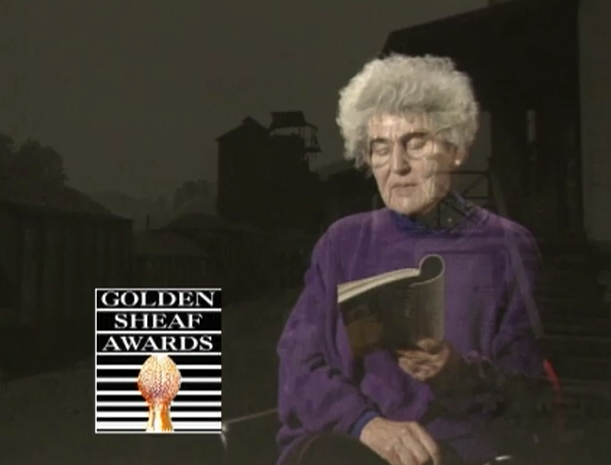
*Yonnondio, a book about the past…* (1991, Beta SP, 15 min.), my first film as producer and director, is a documentary portrait of the American writer Tillie Olsen. This feminist activist (83 years old at the time), whom I met at the Banff Centre for the Arts in Alberta, inspired me with her passion and her still-intact desire for social engagement.
Figure 1: Tillie Olsen (*Yonnondio, a book about the past…*)
I sought to produce a film illustrating Ms. Olsen’s social engagement starting from the late 1930s, in order to inspire today’s audience to pursue the demands for a more just and equitable society. Working with a limited production budget, I opted for a minimalist *mise en scène* of two significant excerpts from Tillie Olsen's first book, combined with a studio interview with the author. During editing, I prioritized the most committed moments of the interview, setting aside those that seemed too directive or potentially patronizing, and then juxtaposed them with the dramatic, emotionally charged sequences. My communicative objective was to attempt to move the spectators—who were not necessarily feminists—to encourage them to reflect on the issues of gender equality and respect. This fifteen-minute film was nominated at the Yorkton Film Festival, screened in a cinema, and followed by a lively discussion with the audience.
Three constituent elements of a reflective framework are put into action here. First, an emotion elicited and directed by the narrative discourse; then, individual or shared reflection (during a discussion); and finally, the search for additional information to pursue this reflection. In this first example of communication, the conditions of distribution play a smaller role than the qualities of the emotive discourse, both in the staging of the book excerpts and in the selected interview moments. My authorial intention was to ensure that the exchanges initiated after the screening would continue and that some spectators would leave with the desire to learn more about the social positions defended by Tillie Olsen throughout her life.
1.2 *Heads Up* (1995)
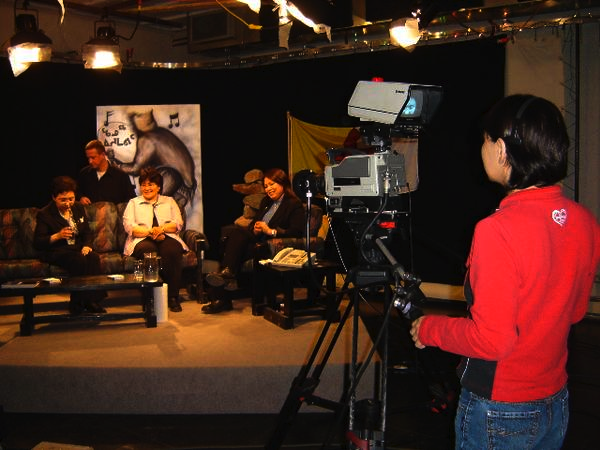
*Heads Up* (1995, Beta SP, 30 min.) illustrates another method of social communication and creation based on a targeted audience. Produced in partnership with the Status of Women department of the Northwest Territories and the Yellowknife YWCA, the film presents women's status issues concerning young Indigenous women. Broadcast on a public television channel, the film was preceded and followed by a discussion between various stakeholders from the women's status sector to introduce and elaborate on issues of self-esteem and family dysfunction. During the broadcast, the phone numbers of government agencies and social organizations appeared on the screen to allow people in difficulty to obtain the necessary support, particularly those living in remote areas far from the city of Yellowknife. As an audiovisual object for discussion and awareness-raising, the documentary was intended for an audience composed primarily of young women, to encourage them to learn about their rights and the resources available to support them in their difficulties.
Figure 2: Social workers in the television studio.
(photo: Gilles Tassé)
During the writing, production, and editing of this commissioned film, I knew that its broadcast would be preceded and followed by discussions among social workers informed about the issues illustrated. I was also aware that the document was being broadcast on the public channel during prime time and that a support network would be available to respond to any potential increase in requests for help. From the outset, I therefore took care to achieve a balance between information and awareness of the social issues exposed, taking into account the viewing conditions, which could become problematic and anxiety-inducing.
Here, therefore, the communication framework is constructed in terms of its outcome outside of its own form. The audiovisual object is in relation with other communication devices: telephone, live TV, and social workers. It acts as the catalyst for a global process of social intervention with specific aims.
1.3 *Drum Making* (1996)
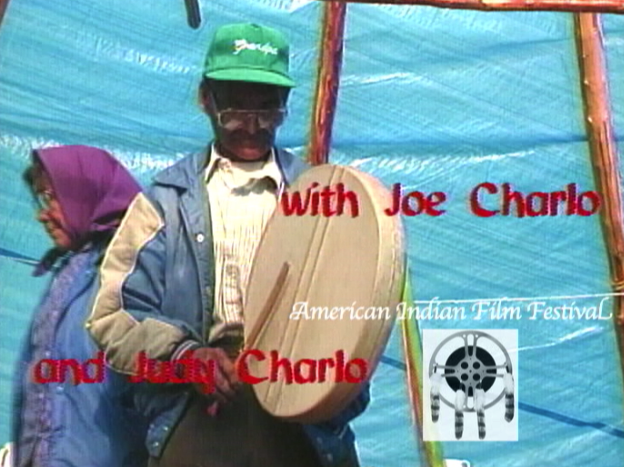
For the production of *Drum Making* (1996, Beta SP, 25 min.), I accompanied a group of teachers to a Dene First Nation fishing camp on an island in the Great Slave Lake, near Yellowknife. For several days, the group followed and recorded the teachings of Joe Charlo, an elder and traditional drum maker, and the last heir to thousand-year-old songs.
Figure 3: Joe and Judy Charlo (*Drum Making*)
(video frame, camera: Gilles Tassé)
In this case, it was a work of ethnographic documentation, the preservation of cultural identity, and the transmission of knowledge. The document was subsequently intended for viewing in secondary school classrooms across various Dene communities in the Northwest Territories, with the pedagogical support of teachers. In the style of *cinéma vérité*, I filmed without interrupting or modifying the process of explaining and manufacturing drums, along with several moments of traditional singing. On a few occasions, I noticed that Joe Charlo paused to allow me to change video cassettes or batteries, and I attempted to minimize the impact of my presence.
During editing, I was aware that the intended viewer was a Dene teenager and that the document viewed in class would be supported by an educator who could stop the viewing at any time to initiate a dialogue and answer questions. I was also conscious that the film would serve a dual purpose as a pedagogical tool for adolescents and an identity-building tool for young Dene people. I therefore wanted both to clearly illustrate each step of the instrument's fabrication and to convey the immense work undertaken by Joe Charlo and the relationship of respect and mutual aid existing between him and his wife, Judy. All this while keeping the film short enough to sustain the interest of young teenagers.
In the same manner as previous works, the film benefits from the support of resource persons and an environment that facilitates dialogue and reflection. Here, the function of the document is twofold: to preserve traditional knowledge in a precarious situation and to promote identity construction and self-esteem among Dene youth.
1.4 Texan Eels on Wheels (2013)
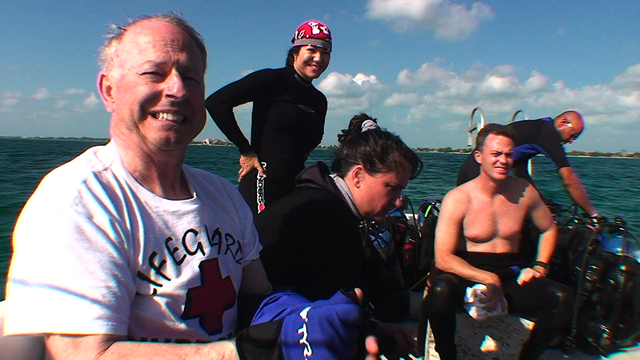
The production of the film *Texan Eels on Wheels* (2013, HDV, 85 min.) was inspired by the experience of John Turkel, a friend and colleague from Los Angeles. Disabled following cancer, he became a member of the Austin-based organization Eels on Wheels, which facilitated scuba diving for people with disabilities. Finding their approach interesting, I decided to produce a documentary presenting certain members of the group: I thus accompanied them to Bonaire and Belize.
Figure 4: Eels on Wheels in Belize. (*Texan Eels on Wheels*)
(video pictogram, camera: Gilles Tassé)
My initial project was twofold: to convey the courage of people fully engaged in their lives and society; and to inform those living with similar physical disabilities in order to offer them advice and encouragement. During editing, I wanted to achieve this dual communication objective aimed at two different target audiences.
This commission proved difficult to fulfill, as the two forms of discourse were not always as compatible as I had hoped. On one hand, the document presents us with inspiring people on vacation and magnificent landscapes, while on the other, it offers technical advice and often dry medical information through classic interviews. The film was invited to the *We Speak Here* festival, broadcast on the Internet and aimed at an audience disposed to viewing this kind of documentary with humanistic qualities. To date, the film has not received any other invitation and has not been accepted into other festivals.
This partial success allows me to address the limits of my linear documentary approach. I submit that in this final case study of social communication, linear narration was unable to respond adequately to the initial communication intentions, which were, moreover, poorly defined and too broad. It would undoubtedly have been wiser to produce a documentary on the diving trip first, and then create a second, more informative and detailed document focusing on the various daily adaptations to which the film's subjects had to submit. The possibility of producing an interactive documentary occurred later, as I was reflecting on the film's presentation at a festival available on the Internet and the various documentary forms that could be distributed there.
1.5 Communication and Reflection Apparatus
As we have just seen, linear documentaries sometimes possess a multifaceted and multitemporal communication apparatus, while the quality of spectatorship they require remains rather traditionally passive. The spectator engaged by the discourse presented to them is free to reflect on what they want when they want, but their participation is not actively required in the progression of the narrative unfolding to which they are exposed. However, the extradiegetic and variable reflexive mechanics—libraries, discussions, readings, additional viewings, etc.—prompted by these linear works resemble certain aspects of the structured and intentional reflection apparatus of the interactive film offered on the Web. I agree that these new interactive works require from their spectator an active presence of reflection and action during their actual experience. But as we will see in the next chapter, this availability or predisposition for intervention is also achieved on discussion platforms between individuals and through hyperlinks leading to other media sources. The "filmmaker" producer thus has the possibility to take this external reflection process into account in the design of the global reflection process they articulate within the very interactive object they are producing. Thus, they also become a communication organizer and a media intermediary. However, to do this, they must both renounce a part of their authority over the unfolding of the work and its experience, and support and accompany the spectator's reflective journey as it occurs either within the work or outside of it, through other apparatuses.
These final analytical elements already inform us of possible modifications in the posture of the documentarian invested in the creation of an interactive documentary, as well as that of the spectator. Sandra Gaudenzi also considers that interactivity transforms the spectator's posture:
Interactivity is seen as native, as constitutive of the digital artefact. The user is not “observing” the digital artefact, not “controlling” it, but “being transformed” by it. (Gaudenzi 2013, p. 75)
She thus allows for a less apprehensive continuation of this reflection on the role of the documentarian as a creator of interactive works who is concerned with the spectator's journey and experience. In the next chapter, I will examine the new multimedia experimentation and communication apparatuses that influence the spectator's path and the quality of their media experience. My intention is to define how these new components of spectatorship now dictate the form of new audiovisual objects and how I can use and adapt my expertise as a filmmaker and documentarian in order to contribute effectively to their production.
New apparatuses – new users – new objects
I would give both audience and technology more agency and assert that the globalized, networked, digitized society demands a new cinema form based on interactivity, play, searching, and nonobvious relationships. (Daly 2010, p. 83)
Examples of the new ludic and interactive cinema described by Daly are already distributed on the Internet. This new cinematic form – hybrid audiovisual works that variably combine cinema, games, and social media – was born from the encounter between the vast capacities of new reception and communication devices and an audience adept at a more active *spectatorship*. These more or less interactive forms, in diverse configurations, escape the conventions of linear narration and habitual discourse, responding to the new expectations for entertainment, information, and experimentation of an audience stemming from a networked, digital, and globalizing society.
At this stage of my reflection, it therefore seems important to examine the evolution of the conditions of audiovisual spectatorship – both technical in nature and in terms of posture – sustained and provoked by new viewing and communication devices, in order to fully understand the influence that this new spectatorship exerts on the unfolding of the experienced objects. This will allow me to apprehend the form that now seems necessary for this new cinema and for the interactive documentary object that interests me. A cinema responding to the profound sociological and cultural changes provoked by the technological evolutions begun with the Internet and the digitization of media barely 25 years ago. A cinema that *a priori* challenges my approach as a filmmaker and whose creation, according to Viva Paci, seems to escape the usual communicative intentions of its creators:
Qu’est-ce que cela veut dire de s’intéresser à un sujet issu de la réalité, travailler longtemps à son étude, investir du temps dans son découpage et dans sa scénarisation pour le web, tout en étant bien conscient que même le spectateur idéal n’en fera pas le tour ? (Paci 2015, p. 164)
Renouncing control over the narrative flow that this interactive form requires seems quite removed from what I am accustomed to accepting as a filmmaker. Indeed, at each stage of production of a linear audiovisual work, every aesthetic and narrative flow decision is carried out toward its most precise and ideal realization possible. During the creation of an interactive work, this meticulous work will find its culmination in experimentation, viewing, and listening devices of variable quality. Moreover, it will proceed from a random unfolding which, by its nature, may leave aside a large part of the formal work performed. However, given the numerous and almost generalized presence of these viewing devices, it seems I must abandon, at least in part, this control over the viewing conditions of my objects, whether they are linear or not.
2.1 New Devices
From my beginnings as a filmmaker, I have witnessed a rapid technological evolution and a significant downsizing of cinematographic and audiovisual production means. Briefly, one can establish the start of this technical and digital revolution at the moment of the appearance of word processing software, which accelerated the pre-production stages of filmmaking and, above all, facilitated the non-linear shaping of the processes of reflection and creation of communication documents. Then, video allowed for an increase in the shooting ratio and the immediate viewing of rushes on set. And, finally, non-linear editing systems favored a more intuitive and reactive editing process, less directed upstream and more flexible downstream. These different digital tools engaged in the cinematographic production process allowed for an increase in the control I could have over the realization of my communicative intentions and a growing precision in the form of the documentary object in which I was invested.
Until very recently, and generally speaking, these new production means still found their culmination in a linear viewing of the audiovisual object as designed for the big screen of a cinema or for a specific television broadcast. However, parallel to the evolution of production means, new distribution and broadcasting technologies have succeeded one another, offering an increasing number of viewers the possibility to free themselves from the linearity and the ephemeral nature of the audiovisual experience. DVD, digital recorders, and audiovisual distribution on the Internet have allowed for personalized viewing schedules and access to a greater number of works, thus provoking a transformation of audiovisual spectatorship. Today, with the possibility of viewing on a smartphone, a tablet, or a computer, it is not only the moment but the very space of viewing that becomes decompartmentalized through this multiplicity of media reception devices.
For Robert C. MacDougall, we are in an era where the place where we are located matters less and less for what we can do there: “Another set of realities illustrates how mobile telephony and computer technology greatly reduce the significance of physical place. Increasingly, where one is no longer matters.” (MacDougall 2011, p. 22). Indeed, it is now possible to watch what we want regardless of location or time, whether it be television programs, films, sports, or other events broadcast even live.
2.2 New Users
There was thus a first digital revolution of production means, then an evolution of distribution means, and now a revolution of audiovisual spectatorship is nearing completion, less and less confined temporally and spatially by the unfolding of the show offered to it and by the reception means necessary for its fulfillment. This current normalization of the presence of film in all places and at all times allows Charles R. Acland to compare the film object to a newspaper that one can leaf through and dispose of whenever one pleases:
The formats that typify today's moving images – such as e-mail links to web-based clips, DVD recordings and episodes of serialized narratives specifically for mobile phones – are closer to the crude ephemera of newspapers and brochures, so unremarkable have they become. (Acland 2009, p. 22)
In fact, many viewing devices are held with one or two hands, close to the spectator, in a familiar manner similar to a daily newspaper. Roger Odin also compares this new filmic spectatorship to the reading of a newspaper or a book. But for Odin, it is in the very form of its unfolding—often interrupted by various events of the current reality or by the technical device itself allowing for other interventions—that this new type of viewing on portable devices resembles reading:
We might describe this new positioning as a move from the position of a spectator to that of a reader: unlike what happens for the performance (of a play, or a film in the cinema), we rarely read a novel from beginning to end in one sitting […] (Odin 2012, p. 159)
Odin introduces an important notion here that directly concerns me as a filmmaker demonstrating reality: that of the activity of the "spectator-reader" who participates actively and voluntarily in the unfolding process. This reading posture, in the literal sense so to speak—the act of reading and scanning words, turning the page, closing the book and picking it up again later—seems for now to represent the most significant and transformative change in spectatorship for conventional audiovisual forms.
However, unlike reading a newspaper, the viewing of a film has, since its origins, taken place in collective or family entertainment venues and through devices whose nature often necessitates a shared experience. Freed from the constraints of broadcast schedules and reception devices, the demobilization of the audiovisual spectacle enabled through these multiple punctual and individual incarnations in time and space now makes the spectatorship experience more solitary than before. Yet, as Jean Châteauvert points out, paradoxically, it is with the help of a communication device that this moment of individual spectatorship often unfolds, and it is thanks to the exchange capacities of this new device for experimentation and viewing that a new sense of spectator belonging is established:
In the immediacy of viewing, which is relative and variable depending on whether one is watching a news bulletin, a singer's latest music video, or the posting of the latest episode of a television or web series, the spectator can interact at the moment when reaction and commentary are relevant among internet users. The mobile platform adds to the viewing experience the possible 'live' participation in a virtual network that is created among internet users around the series or the subject. (Châteauvert 2014, p. 15)
This dialogue, carried out in parallel by the spectator using the viewing device or any other device in their possession, modifies the spectator's qualities—their ability to understand and follow the discourse, their concentration, their availability of time and attention—by allowing an engagement toward the realization of other intentions; multiple intentions of communication, entertainment, and information. Consequently, in my view, it is much more than a spatio-temporal liberation of the filmic spectacle that is provoked by the multiplicity of viewing and interaction platforms. It is the very singularity of the ongoing audiovisual experience and the uniqueness of the engagement it requires that disappear during its more or less linear unfolding to which the spectator has invited themselves. Does this multiplicity of punctual and parallel engagements necessarily lead to a clear loss of quality in spectatorship, or is it rather a modification of presence and a shaping of different intentions responding to social and technological evolution?
According to Kristen Daly, the spectator engaged in experiencing a film, regardless of the platform used (cinema screen, TV, computer, tablet, phone, etc.), requisitions new multimedia and multitasking devices for other media and communication functions during the ongoing spectatorship experience in order to optimize the value of the global media engagement:
For Cinema 3.0, a movie no longer exists as a cohesive, unchanging art piece but instead participates in a world of cross-media interaction, and this has enabled new forms of narrative requiring, as part of the enjoyment, interaction in the form of user-participation and interpretation. (Daly 2010, p. 82)
Daly highlights here two essential elements for the understanding I am building of my new approach as a creator of interactive documentary works. First, she explicitly emphasizes that a film distributed on the Internet no longer exists as an integral, coherent, and singular object, and that we must instead consider it as existing within a network of intersecting media offerings. Then, she prompts me to consider that this networked existence and this new spectatorship—whose pleasure is based in part on interaction—can cause a fragmentation of the experimentation with the object during viewing. Indeed, as Sean Cubitt noted as early as 1998, the appeal of the interface, due to its design and its interactive and navigational capacities, steers the user toward an active presence with multiple engagements:
Peering into the screen, the browser interface invites you to enter not the internal workings of one machine, but the composite ensemble of all linked terminals. The facilitating hardware, increasingly transparent as user-friendly, icon-driven designs become second nature to synergetic subjects, has loosened its grip on materiality to present itself as a vast virtual playground […] (Cubitt 1998, p. 83)
This new media and network landscape—this vast virtual playground—would thus foster the creation of new audiovisual forms and new multimedia functions that are appreciated by the spectator based on the different possibilities for interaction and participation allowed, whether intra-diegetic or extra-diegetic. The spectator's desire for multiform and multitasking engagement expresses itself as much outside the experienced form as inside it, using various media devices that are more or less incidental or linked to one another.
2.3 New Objects
The media ubiquity of spectatorship and virtual presence offered by various communication devices and multimedia experimentation platforms has thus provoked a fragmentation of the audiovisual experience and a multiple shaping of spectator engagement, as viewers now have the possibility of investing in a multitude of experiences within the same global process of reflection or entertainment. For example, today, during the broadcast of a hockey game aimed at a large, captive, and already-won-over audience, it is simultaneously possible to watch the game on a television or on the Internet—via tablet, phone, or computer—while interacting with other users through the broadcaster's blog, browsing statistics regarding certain players, and even accessing another level of information constructed from a multimedia and graphic formatting of match statistics. The spectator's engagement is here both divided (by parallel and related applications and objects) and multiplied (by the relative degree of connivance existing between them). In this example, the media shifts undertaken by the spectator are oriented toward the same object (the retransmission of the match) and the same event (the hockey game) and are thus part of the same global space of entertainment.
New digital broadcasting devices and network distribution systems therefore foster new modes of viewing and media participation, which in turn influence the form of the audiovisual objects presented therein. These are autonomous forms that serve their utility of global and multiform engagement as much as they serve their unique representation and singular experimentation. The media industry is already utilizing this transformation of spectator presence and this evolution of media consumption. It offers not only varied and adaptable actantial devices for the same spaces of entertainment or information, as we have just seen with the retransmission of hockey games; it also leverages the browsing and participation data of its visiting spectators through marketing and advertising, in the same way it does with traditional ratings.
Regarding my own work, and as I explained in the previous chapter, the documentary objects I created sometimes found their fulfillment outside of their own experimentation. Once their viewing was complete, these works continued to prompt reflection and information seeking, and were able to continue their communication process through other information sources and through the experimentation of other objects. There is, however, a difference between creating a work whose viewing will spark a desire to experiment with additional objects in order to deepen an already initiated reflection, and the creation of an interactive object that will be all the more appreciated insofar as it allows the spectator to abandon it during its own experimentation. How should I approach my object and structure its communication and interaction offering when it is dependent on other offerings and other actions that modify the unfolding of the offered experience, the latter being undoubtedly subject to frequent exits from the spectator's presence?
Referring to Lev Manovich, Marida Di Crosta clarifies the function and nature of the interactive film and allows for an approach to the dual function of the "screenic" surface. For her, the interactive film is rather a film-interface, a global device where the film and the interface are components of the same object:
In technological artifacts, it is the interface that, by structuring the spatio-temporal configuration and the organization of the screenic surface, redefines each time the particular formal, material, and phenomenological organization of the experience. Consequently, the interface cannot be thought of as separate from the content, since it determines the very materiality of the object and the experience: a simple change in the interface and the meaning of the entire work would be considerably altered. (Di Crosta 2010, p. 156)
It seems, therefore, that I must modify my grasp of the interactive documentary object in order to broaden my understanding of its *raison d'être* and its discursive mechanics. In agreement with Di Crosta, I believe that the interactive documentary film is not a navigable film with an interface, but rather an interactive device offering a variety of navigation, interaction, and viewing experiences, with a documentary component, filmic or otherwise. And as Daly previously indicated, it also seems essential to take into account that the interactive documentary exists in a world of "cross-media" interaction (Daly 2010, p. 82) and must therefore be considered as a place of passage, stoppage, and return, rather than an end in itself.
I propose a comparison inspired by my previous studies in urban planning. The web documentary would have a function similar to that of a public square in a city: that of being a space of passage, action, and interaction within a vast network, whose utility and function exceed the value of its simple punctual use. Manovich considers the interface in a similar way. For him, it is indeed a space that exists as a site of action and presence, but also, and above all, as a mental space, constructed of moments of perception, reflection, action, and memory. A place that is transitory and ephemeral in its form, but continuous in its reflexive mechanics:
Rather than considering only the topology, geometry and logic of a static space, we need to take into account the new way in which space functions in computer culture—as something traversed by a subject, as a trajectory rather than an area. (Manovich 2000, p. 279)
The web documentary should therefore be considered as a space that is simultaneously virtual, digital, and graphic, and as a mental space in perpetual, more or less continuous construction for the spectator. This is somewhat like video games which, through a narrative device shaped within a graphic environment and rendered "tangible" through possible actions, place their user in a predisposition for play and assign them their primary purpose. Once the player is immersed and informed, the graphic aspect remains but gives way to the *raison d'être*, the game. Dominic Arsenault explores this ludic notion of domesticating possible virtual action and navigation:
Every video game thus begins with a more or less long period of experimentation, which depends on the player's video game culture and the complexity of a given game, during which the player mentally maps the repertoire of actions offered to them. (Arsenault 2013, p. 257)
The web documentary, for its part, would place its user in a predisposition for reflection and information seeking concerning a reality and its representation in different forms. Since the user's interactive actions are rooted more in a desire to understand and in curiosity, the presence required would be similar to that required by discovery video games where the player is called upon to understand and to act in order to understand more. However, the interactive gestures that allow for this evolution of understanding are devoid of actantial narrative pretext or character incarnation. They are initiating gestures of reading and viewing, sometimes of writing and communication, which expose the user to more information and predispose them to greater understanding. They are integrated and actualized according to an interface offering different gestures and devices for information, communication, and reflection. According to Viva Paci, these different devices of reflection are shaped and made available to the active spectator by a creator who is less interventionist than the linear filmmaker, but still required and still the signatory of the work:
[...] we want to emphasize the issues related to interactivity. They are embodied by the notion of the interface. Opaque or transparent, the latter contributes to mobilizing behaviors in the user that will determine their posture, and thus the aesthetic regime of the work and its reception. Interactivity is therefore also the site, specific to the web documentary, through which the author can share their relationship to the world. (Paci 2015, p. 161)
The research elements that have guided my reflection thus far clearly indicate that the form of audiovisual and multimedia experiences is currently influenced by new qualities of spectatorship engendered by new viewing and communication devices. However, Paci introduces here the notion that the very form of the interactive object can influence, or even model, the spectatorship of the moment that is actualized through interaction. An interaction which, in my view, allows both the spectator to construct and direct their reflection by mentally mapping the repertoire of actions offered to them (Arsenault 2013, p. 257) and the creator of the interactive work to share their relationship with the world (Paci 2015, p. 161).
Unlike the linear documentary, this new interactive form of reflection on reality thus seems to be constructed from several layers of information and meta-information (metadata) presented through an interface, and must not be considered or approached as a unique, linear, and limited experience. Moreover, if the form of this new object seems controlled by and subject to a new spectatorship established by new media devices, its experimentation appears both capable of benefiting from the multitasking trends influencing this new *spect-actor* and satisfying their new expectations of multiple engagement:
Cet espace est en perpétuelle communication avec d’autres espaces et d’autres individus investis eux aussi dans d’autres formes et d’autres espaces de communication comme facebook, tweeter et textos. La sociabilité du Web devient partie intégrante du webdocumentaire. (Tremblay, Tassé 2015, p. 3)
This documentary form is therefore not to be conceived so that a spectator, even an ideal one, might see the whole of it (Paci 2015, p. 164). Rather, it exists as a range of possibilities, more or less directive and multiple. And it is made available to the *spect-actor* to allow them reflection and discussion regarding an exposed reality. The *spect-actor*, free to leave and resume their participation at any time, is in control of their journey. They will be, as they wish, in communication and interaction with other objects and other participants, according to their choices and the space for reflection that we will have installed with and for them.
According to Robert C. MacDougall, the responsibility of the creator of interactive works even exceeds the limits of the space and the interactive object. They would be responsible not only for this space of reflection shaped by the interface and through interaction, but the "lived" media experience would have repercussions on the very construction of the user's reflective capacities:
New methods of observing and measuring brain activity and the burgeoning field of epigenetics (essentially, the study of genetic change that occurs above or after the genome) suggest that the media choices we make today will be consequential with regard to the way future generations will think about, perceive, and interact in, through, and with their worlds. (MacDougall 2011, p. 22)
These considerations go beyond the intentions of this thesis but nonetheless echo the remarks of Sandra Gaudenzi cited in the conclusion of the first chapter: "[…] The user is not “observing” the digital artefact, not “controlling” it, but “being transformed” by it." (Gaudenzi 2013, p. 75). I note therefore, in concluding this chapter, that the communicative media object, interactive or not, has multiple intentions: some punctual ones that are actualized through the course of viewing and interaction; and others taking shape over the long term, following a possible process of reflection. My previous linear creations had similar aims and also desired to be inscribed in time. My forthcoming interactive documentary object will also manifest similar intentions. And it seems that the open and adaptable form it is set to take makes it even more capable of achieving this. In the next chapter, I will examine two interactive documentary works on which I collaborated. Works that are both coherent and clear in their communicative intention and effective in their capacity to stimulate and sustain reflection. They inspire my current research-creation process and establish a link between my past linear works and the upcoming interactive work.
Short interactive retrospective
From 1996 to 1999, I participated in the experimentation and production of interactive documentary works at Interval Research Corporation, a laboratory and technology incubator in Palo Alto, California. At this stage of my research, almost twenty years later, as the technological context has changed and I am reflecting on this mode of documentary representation, a brief review of several important communicative intentions from this experimental period appears useful for the progress of my reflection. Furthermore, these collaborations strongly influenced my current desire to explore the interactive documentary, and the quality of the works produced and the collaborators of that time still inspire me today in my approach as a researcher and creator.
For three years, I collaborated on various forms of interactive documentary, discursive, and reflexive devices. My primary collaborators were Michael Naimark and Rachel Strickland. For over 30 years, Michael Naimark has explored various devices for the capture, representation, and virtual experimentation of real spaces and environments using new media and immersive installations. Architect and documentarian Rachel Strickland is interested in the various portable systems that people deploy to carry the personal belongings they need for daily life. At the time, Rachel Strickland was building a database of navigable and interactive information, images, and video portraits.
3.1 *Be Now Here* (1995)
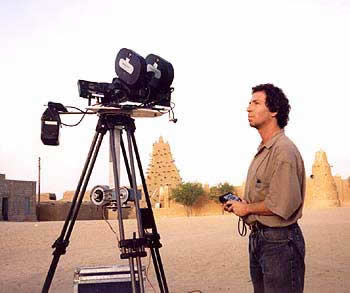
I collaborated several times with Michael Naimark on different space-capture projects while I was working at the Banff Centre for the Arts and Interval Research Corporation. I am interested here in *Be Now Here* (1995), an immersive installation constructed from 3-D stereoscopic film documentation of four sites on the UNESCO List of World Heritage in Danger: Jerusalem, Dubrovnik, Timbuktu, and Angkor in Cambodia. These are historical sites that have been differently compromised over the last century by war and conflict and which bear their scars. For instance, the monuments of Dubrovnik are marked by bullet and mortar traces, the Wailing Wall in Jerusalem is controlled by the military, etc. I assisted Naimark for the shoot in Timbuktu and was present during the preparations for the work’s first presentation in San Francisco.
Figure 5: Michael Naimark in Timbuktu for the filming of *Be Now Here*.
(photo: Gilles Tassé)
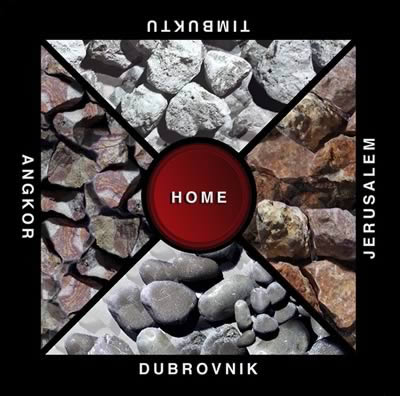
Each heritage site was filmed at sunrise, sunset, and in the afternoon from a unique viewpoint, one that best captured the physical and historical characteristics of the location, as well as the human activity taking place there. During the experience, visitors to the installation wear 3-D glasses and, by means of a physical interface device, choose the location they wish to see and thus visit. When a visitor presses the name of one of the four cities appearing on the interface, the projection screen shows the new location at the same time of day as the one it succeeds. If no action is taken by a viewer and no voluntary change of location is made, the system presents all segments of the same location one by one, then proceeds to the next location. When a visitor presses the HOME button, the projector shuts off for a few seconds, the intensity of the lights in the presentation room increases slightly, and each visitor has the opportunity to notice the presence of other visitors, as well as their actual location of active presence: the exhibition room.
Figure 6: Physical interface of *Be Now Here*.
The names and the rocks are the push-buttons allowing the choice of the virtual visit site.
Online. http://www.naimark.net/projects/benowhere/benowhere_i3.html. Accessed April 25, 2015.
This interactive and immersive device thus offers visitors the possibility to conceptually parallel sites that, although foreign to one another, all possess heritage value made fragile by conflict or war. The visual and immersive juxtaposition of different locations prompts a reflection that highlights the element of human responsibility in the degradation or disappearance of these unique places. Furthermore, the device’s HOME function places the visitor in a situation of personal questioning and accountability regarding the issues presented.
This project appears to me to possess a particularly effective interface due to its simplicity in communicating the choices offered to the visitor and in clearly and directly responding to the interactive gestures they are led to perform. Moreover, the interactive limitations of the device—five interaction possibilities—promote clear and simple communication, making it easy to master. This allows the visitor to more easily experience the sense of immersion offered by the device, to better feel the evocative emotion of the locations, and to continue their reflection. These are qualities of communication and interaction that I will attempt to promote in the development of my own interactive documentary object and in the design of its interface.
3.2 *Portable Portraits* (1989-1998)
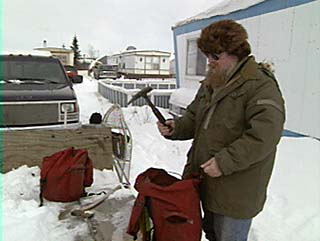
Rachel Strickland’s *Portable Portraits* (1989-1998) is the project I collaborated on most extensively during my time at the Palo Alto think tank. It consists of a series of documentaries focusing on a variety of people of all ages and backgrounds and their daily portable systems: backpacks, jacket pockets, briefcases, etc. The video segments are designed to be both navigable toward similar videos and "viewable" independently.
Figure 7: Walter Humphries, gold prospector, at Yellowknife, April 1997. Online.
http://www.portablefx.com/system/portraits/WalterHumphries.jpg. Accessed April 23, 2015. (video thumbnail, camera: Gilles Tassé)
As an editor, I had to ensure narrative and visual coherence for the documentary segment in its linear progression while making its possible abandonment toward other segments of similar content as fluid as possible at specific, pre-established moments. The entry and exit points of the various video segments had to be established to maximize the fluidity of the match cut, while allowing for the optimal completion of the segment currently being viewed. It should be noted that at the time, the technical means for interactivity and viewing did not yet permit the creation of a truly functional platform.
Figure 8: A continuous media flow showing; (0) a passive jump;
invisible extension; (2) premature contraction. (Freeman 2000, p. 5).
Considerable time and effort were invested in constructing a semblance of narrative linearity during the development of this interactive prototype. Among other tasks, numerous hours were devoted to subtracting or re-adding a few frames to the hundreds of video portraits in order to make the transition between different segments as fluid as possible during hypothetical exits from the current linear narrative progression. This focus on maintaining narrative fluidity following a spectator's interaction illustrates a certain conception of interactivity that now appears to me less necessary, if not less effective.
3.3 Device of Interaction and Reflection
Today, following the reflection underway in this thesis, it seems to me that this global, networked, and digital society (Daly 2010, p. 83) calls more for an interactive documentary cinema that highlights the exits from narrative progression made by the spect-actor. Indeed, the spectator's actualization of their desire to know more—which is achieved through some actantial gesture—first requires from them a clear will to understand and a desire to make the decision to act to achieve it. These are qualities of presence that are not dependent on the fluidity of narrative immersion or passive identification with a character. We must consider the interactivity of this new cinema as a device for accountability and engagement for the user, allowing them to validate both their presence and their actions throughout their journey.
I submit, therefore, that the presence of audiovisual indications—whether interfacial or filmic—during clearly assumed moments of diversion from the linear necessarily corresponds to the voluntary moments of meaning-connection that the spectator is performing. This quality of experimentation and interaction allows the user both to anticipate and to immediately perceive the consequences of their gesture. Thus, it is possible for them to fully grasp the impact of their active presence within the enunciating device and to assume responsibility for the progress of their reflection. And as I emphasized in the second chapter, the new user of communication devices is entirely ready to take and assume these opportunities for diversion offered to them—opportunities which, according to my expertise, can direct them even further into the reflection I offer them.
The memory of this desire for fluid narrative expansion and the reflection it provokes at this point in my research reveal a certain rigidity of the linear that I have always assumed and taken for granted, without, however, being fully aware of it. It seems important to highlight this new approach I have toward interactivity, as I still recently intended to give the most fluid form possible to my offerings of interaction and navigation of documentary content. Indeed, it was only during the writing of this short chapter, while I was still immersed in the reflections of the previous chapter, that I suddenly understood this change in my perception of interactivity.
3.4 Navigation and reflection by icons
Conversely, an element of the interface prototype designed for *Portable Portraits* still seems innovative and relevant today in the development of my own interactive documentary object. In summary, the documentary content of the various videoclips forming *Portable Portraits* was analyzed and categorized using an icon-based identification system, established according to data collected concerning the different portable systems documented. These icons, representing categories of subject, verb, or complement, allowed for an identification and classification of the informational nature of the audiovisual material during viewing; for example, woman – briefcase – work, or man – backpack – food, etc. This categorization of informational content was established to subsequently allow for the creation of links with certain sequences present in other video segments, much like keywords during an Internet search. During a future viewing and a probable interactive experimentation (following the prototype's planned evolution at the time), icons were intended to appear on the screen to inform the spectator-navigator of the existence of sequences that might interest them because they were related to various themes present in their current viewing. By clicking on one of the thematic link icons, the spectator chose to undergo a narrative diversion and engaged voluntarily and more deeply in their ongoing reflection. They chose the theme, duration, and direction of their reflection, even if it meant changing their mind later and pursuing another direction. They controlled the narrative flow of the device and directed the progression of their reflection.
I retain here the capacity of this interface to identify the quality of the informational content during viewing and to offer the possibility of navigating it based on the participation and reflection criteria of the moment. Furthermore, this interactive device allows the spectator to quickly understand where they are and where they might also be interested in going. It is an interface that thus participates in the active reflection concerning the content currently unfolding and that which is potentially to come; and which is therefore of navigational, narrative, and cognitive utility all at once. Let us return to this approach that once occupied me in order to highlight two things that seem particularly important today in the development of an interactive documentary work: the necessity of breaking free from the weight of linear narrative heritage and the importance of a clear informational navigation interface that participates in the ongoing reflection. This is an observation on the necessity of the spectator's reflective engagement that Kristen Daly shares, though for different reasons.
According to Daly, the boundary between the various aspects of our lives—work, entertainment, communication, information, etc.—is no longer as well-defined as it was in the still-recent era when the tools necessary for their accomplishment were all distinct. Today, this flexible or porous boundary between these different types of activities using the same devices—phone, tablet, computer, etc.—means that the separation between creator and spectator is no longer so clearly defined. This distinction of activity is established variably through the objective and quality of the media interaction at hand. An interaction that becomes, in fact, reflective because it has a changing and adaptable intentionality depending on the moment:
Increasingly, for computer and mobile users, existence is in some intermedial zone of work and leisure; the experience of moving images through computer and digital technologies is interactive, blurring the lines between producer and consumer, spectacle and spectator, representation and information, as embodied by mashups and crowdsourcing. To represent these new sets of relations between art, culture, work, and relations of power, Cinema 3.0 must move beyond vision to engage thought. (Daly 2010, p. 86)
I draw upon the reflection carried out in the first three chapters to develop the formatting of my interactive documentary object and to construct its offer of reflexive engagement which will, I hope, allow for a relationship with the spectator that goes *beyond vision*. The next chapter reports on this process of design, creation, and communication carried out in two distinct stages: a first stage of producing media assets (originally of linear formal intention); then their contribution to the development of my interactive documentary. It is written with the same concern for understanding how the web-documentary can be a tool for reflection on reality and how I can contribute to it.
Autopoietic interactive creation
[…] the construction of social reality is also done through media. In our case it is the positioning that the media makes possible for the individual that “places” such person in a set of possibilities. This is where there is a big difference between linear and interactive documentaries. Interactive documentaries are relational artefacts that allow direct engagement with the reality that they portray […] (Gaudenzi 2013, p. 37)
For Sandra Gaudenzi, this possibility of direct engagement with the represented reality—and by extrapolation with the society in which it is situated—is the essential characteristic of any interactive documentary object. As a documentary filmmaker creating an interactive work, I understand that I must do more than engage the viewer emotionally or intellectually through an "engaging" work. Rather, I must engage the viewer directly in the unfolding and experiencing of the documentary representation in progress, and thus in and with the society from which it is extracted. As a researcher, I felt it would be interesting to carry out this interactive formatting using audiovisual material filmed with prior linear formatting objectives in mind. This allowed me to compare the creation of a linear work to the development of an interactive work, and to better understand the differences in creative investment required by the two processes.
In this chapter, I analyze the design and production stages of my interactive documentary object in order to account for the creative process as a whole. It may still seem paradoxical that after having proceeded in a precise and reflective manner through all the formatting stages of the documentary object, I was willing to leave the final stage of its completion in the hands of the spectator. Arnau Gifreu also questions what happens to the viewer's experience following this more or less partial relinquishing by the filmmaker of formal and experiential control over the documentary work:
In traditional documentaries, the author’s ability to influence the audience is taken for granted, and this influence is exercised through filming and the discursive structure coordinated via editing and staging. But, what happens when this ability is given, at least, partly, to the documentary audience? What happens when the audience is not only audience but the creator of their own documentary experience? (Gifreu 2011, p. 355)
From the beginning of this research work, my main objective has been to discover what happens to the audiovisual work and its creator when the latter yields to the *spect-actor* a significant part of their influence over the documentary experience as it unfolds. I undertook the production of my web documentary with the same objective. My research guided my creative choices and helped shape my interactive object. I will now examine each production stage, paying particular attention to the evolution of the documentary object and the nature of my involvement.
4.1 Ideation of the work in two stages
As I mentioned in the first chapter dedicated to some of my linear productions, the production of the film *Texan Eels on Wheels* was initiated by the experience of a friend who became a member of the diving organization for people with disabilities Eels on Wheels. Having just celebrated his 38th birthday, he confided in me that the cancer he had been battling for several years had damaged his spine. In the same breath, he announced that he was preparing a second diving trip to Belize with a group of divers with disabilities based in Austin. I felt at that moment that there was an inspiring life story to be told.
All the audiovisual productions in which I have participated in the past were initiated by similar stages of awareness and reflection. After being informed and touched by a social, human, or cultural issue, I would decide to reflect on it in order to express myself on the subject through the production of an audiovisual work. Regarding the film *Texan Eels on Wheels*, the initial creative emotions were: inspiration in the face of courage and empathy for the hardships faced. This subject also allowed me to address notions of human adaptability, family and community support, and friendship. Subsequently, the limited reception and distribution of the work prompted me to explore new ways of sharing the stories of these inspiring people. It was therefore with the same sense of respect and admiration for them that I approached the production of the interactive work *Texan Eels on Wheels*. Nevertheless, this time I had to return to my initial creative intentions and ignore the existence of the linear form and the disappointment felt at its poor reception. I had to consider the subject as it usually appears before it is formatted—that is, for what it is, what it says to me and what it can tell others, and how it can do so through the envisioned form, even an interactive, adaptable, and multiple one. In this case, however, I was starting from interviews and images that had already been filmed.
4.2 Production of the audiovisual components
Filming took place in three main stages: a first diving trip to Bonaire, another to Belize, and finally a series of interviews in Texas and California. Before departure, I took an intensive PADI certification course in the University of Montreal swimming pool. Having already an idea of my communication intentions, it was important that I be able to witness these underwater activities and be responsible for documenting them. My primary filming interest during this first trip was twofold. On one hand, I was inspired by people with disabilities engaging in a complex, potentially perilous sporting activity far more confidently than most of us would. On the other, I was interested in these assistants of diverse abilities and varied expertise—dive masters, nurses, physiotherapists, etc.—who support the divers with disabilities and share with them the pleasure of this demanding sport.
Handling the camera proved to be very easy, as diving allows for an almost instinctive movement of the body in three-dimensional space. However, the lighting conditions and variable transparency of the water made the use of zoom and long focal lengths ill-advised. Over the course of the filming days, I realized it was more effective to use the widest focal length possible and to film in automatic aperture and focus modes. I established the framing by positioning myself as close as possible to the subjects, while being careful not to affect the enjoyment of their dive.
Figure 10: Gilles Tassé in Belize for the filming of the film *Texan Eels on Wheels*.
(photo: John Turkel)
As a filmmaker and documentary cameraman, I have always minimized the influence of my presence on the unfolding of the events I was documenting. However, during this shoot, I was not only a participant in the events in progress, but I was also responsible for a task that was sometimes incompatible with the fulfillment of my production work. Indeed, diving is performed in pairs—and with three divers when accompanying a person with reduced mobility—so that there is always someone capable and available in case of need. I was the partner of my colleague and friend John Turkel. During one of our first dives, I forgot this important responsibility. I followed a massive turquoise eel for about ten minutes and filmed a long *plan séquence*. At the end of filming this shot, I realized that I had abandoned my partner and strayed from the group of divers. These specific filming conditions sometimes made my work as a filmmaker more difficult. Being directly concerned and involved in the events in progress, I lost the usual distance necessary for the smooth running of a shoot.
Six months later, I went diving in Belize with the same organization, accompanied by additional divers. I wanted to make a second trip to meet other potential subjects and shoot new underwater footage. This time I was better prepared technically and knew a bit more about what I wanted (and what I was doing). However, from the beginning of this trip, my friend and colleague from Los Angeles became very ill. I assisted him to the best of my ability, and I dived less, and consequently filmed little.
During the few months preceding the shoot in Texas, I planned the next steps for my project. I decided to focus the narrative on the people with disabilities—and leave out the other members of the group—as their life stories were rich and sufficient in themselves for the development of a satisfying narrative. I asked about ten disabled divers to participate in the production of the film and received six positive responses, as some divers preferred not to share their private lives on camera.
The Texan subjects lived quite far from each other, from Dallas to San Antonio. Since they had become my friends over the course of the trips and dives, they all offered me hospitality during the few days I visited them. Thus, I was able to get to know them better and properly prepare the interviews, and I filmed sequences of their daily lives during leisure and work activities. Once again, I was filming alone. I filmed the interviews using a fixed frame in order to remain intellectually and emotionally available during the conversation.
Throughout my career as a filmmaker, I have worked as a director, director of photography, and editor. I always conceive my films based on each of the production stages they necessitate and with full knowledge of the technical and organizational requirements they require. Each stage builds on those that preceded it and is established according to those that will follow. However, regarding this interactive work, the video documentation was carried out before I envisioned the creation of an interactive work and its distribution on the Internet. It was therefore only at the final multi-stage phase (Web and interactive) that the production process was able to partially free itself from its linear heritage and finally be conceived in its interactive form. It is probable that I would have filmed the interviews differently had I known in advance that they were to be used in the creation of an interactive work viewed on a computer or on various mobile viewing and interaction devices—tighter framing for interviews, subjects addressing the camera directly, etc. But since the audiovisual material is already shot, let us return briefly to the content of the video tapes to better understand the choices subsequently made in the construction of the interactive work.
4.3 Media Assets
There are first six interviews of approximately 60 minutes each featuring two women and four men confronted with a dramatic event that left them disabled. Lynette Kunz, from Harker Heights, is a singer and theater actress. Joseph Murphy, from Austin, is a dental surgeon. Patricia Parnell, from Pflugerville, is an IT analyst at Dell. Neil Peltier, from Helotes, is an operational supervisor at SeaWorld San Antonio. Don Rorschach, from Irving, is a retired lawyer and dog advocate. John Turkel, from Los Angeles, is an information technology consultant.
Each of them testifies to those moments when they had to demonstrate qualities of courage and will, allowing them both to overcome these demanding ordeals and to live a fully satisfying and engaged life. For each of them, there are also, to varying degrees, video sequences of various activities—work, leisure, cooking, etc.—with family or friends. Finally, there are sequences of travel and diving, including the different stages of transport by plane and boat, festive moments of camaraderie, and dive preparation. I witnessed the courage of these disabled divers who allow themselves to be thrown overboard with their heavy and cumbersome equipment while they are sometimes completely physically helpless. They demonstrate great confidence in their abilities, as reduced as they may seem, and in those of their companions, who are always by their side.
4.4 Development of a Formulation and Interaction Design
Before the stage of formatting the interactive documentary object, I participated in two short workshops exploring the web documentary led by the researcher Sandra Gaudenzi (cited several times in this thesis) which took place at Concordia University in Montreal in March 2015. Sandra Gaudenzi emphasized the particular creative process of these interactive works, which require their creators to first and foremost understand the expectations of their future users. She urged us to put ourselves in their shoes and offer them what they want, what they need. As a filmmaker involved in the production of an interactive work, it was at this moment that I understood it was about doing much more than what I used to do at the editing stage of a linear work where, receiving the work in progress, I judged its potential reception by the spectator. The interactive documentary work places the user at the center of its apparatus (*dispositif*). This seems obvious. But it involves a fundamental paradigm shift for a filmmaker engaged in the creation of a new object. It involves fundamentally accepting that the interactive work only exists at the very moment of its actual experimentation.
Janet Murray highlights this particular media creation mandate even more clearly. According to her, an interactive audiovisual experience will be satisfying for the spectator to the extent that it can offer a tangible result to the actions they undertake:
When the things we do bring tangible results, we experience the second characteristic delight of electronic environments – the sense of agency. Agency is the satisfying power to take meaningful action and see the results of our decisions and choices. (Murray 1997, p. 126)
Opening the chapter, Sandra Gaudenzi explained how the interactive work offers the *spect-actor* an engagement in the unfolding of the experimentation of a certain representation of reality and, by analogy, a direct relationship to the society from which it is extracted. These conclusions align with my own communication intentions and allowed me to better understand the reflexive mechanics of these interactive works. As for Janet Murray, she prompts me to consider the shaping of the interactive object even more concretely by informing me about the narrative mechanics of the interactive process and the degree of satisfaction of the experimentation and interaction process, which is fulfilled through clear actions followed by concrete results.
During my first graduate university session, I designed a prototype of my interactive object using rudimentary digital tools. My intention was to initiate a reflection on interactivity and to test some of my intuitions regarding interaction and navigation. I retained a few navigation and interactivity ideas from this first experiment for the creation of the new interactive object. I notably kept the navigation via content category icons that I had developed from public domain icons, which I sometimes modified. At the time, I had established about twenty content categories such as personal care, work, travel, healing, support, question, home, etc., based on the themes emerging from the interview content.
Figure 11: Examples of category icons for the Texan Eels on Wheels prototype
(in order: Accident, Difficulties, Personnal Care and Food). Icons designed by Lorc. CC BY 3.0. Online http://game-icons.net/. Accessed June 23, 2015.
I appreciate these icons as they are easy to understand and perceive. Their graphic simplicity allows them to be easily inserted into the screen space without cluttering the *spect-actor's* field of vision or distracting them while they are engaged in the unfolding of audiovisual content.
During the experimentation of this first interactive documentary sketch, I was confronted with certain limitations of web hosting, as audiovisual playback stops often interrupted this much-sought-after engagement from the spectator. Following this observation, it appeared more efficient and responsible to place my video assets on a hosting and broadcasting site specifically designed for this task, such as Vimeo, Google, YouTube, Yahoo, etc. However, before choosing the video file hosting best suited to my needs, I had to consider the method I was going to use to embed interactivity into the documentary work.
The HTML5 language allows for the manual insertion of interactivity tags (markers) when encoding a website containing interactive videos. Although manual encoding (HTML5, JavaScript, and CSS) is relatively efficient for programming and structuring interactive events, writing it quickly becomes tedious and restrictive as screen position adjustments and synchronization must be applied to the various events. Several platforms are available to perform this formatting and encoding. Each in their own way, they allow for different possibilities in constructing interactive offerings, such as active social media windows, a questionnaire appearing at a specific moment of viewing, a link to another video, etc. My choice settled on Klynt, a platform that is more difficult to master but allows for more interactive possibilities as well as greater precision in the implementation of the interaction offering.
Following this choice of interactivity construction platform, I was able to decide on the hosting mode for the video files. The "education" version of Klynt that I used allows for referencing videos hosted on YouTube, or directly to the address of their viewing (and hosting) site. However, as I mentioned, few web hosts offer a video viewing speed capable of meeting the requirements of an interactive audiovisual work. YouTube, for its part, allows for a download speed compatible with interactive viewing and video resolution and compression qualities consistent with my audiovisual quality requirements. I therefore uploaded the videos to YouTube and designated them as unlisted (and not private) so they could be referenced during the HTML5 encoding of the website.
At this point in my analysis, it seems relevant to briefly recall the stages completed during the production process in order to clearly understand the remainder of the journey and the important choices that remain to be made.
4.5 Summary
First, I evaluated the narrative and informational quality of the documentary audiovisual assets. Then, I defined the main communication intention of the interactive work and determined in a general way the type of icon-based navigation I wished to offer. I also thoroughly researched the engaging nature of these interactive documentary works (Gaudenzi 2013, p. 37) and how they must be constructed to involve the *spect-actor* in a satisfying way (Murray 1997, p. 126). Finally, I chose the digital, web, and interactive tools necessary for the remainder of the creative process. The creative process was thus unfolding according to my forecasts, step by step, without major technical problems or moments of disillusionment. However, a few important points still remained to be clarified before beginning the shaping of the object.
When, as a filmmaker, I perform the editing of a (linear) film, I build a sequence around an action or a testimony. I look at the available shots, evaluating their aesthetic quality and their narrative and informational relevance. Throughout the editing process, I react to the narrative construction in progress and am able to validate my choices by observing their effectiveness during a viewing conducted at the editing station. However, during the construction of an interactive work, the possibilities for metadata, navigation, and interaction are virtually infinite. As a creator, I therefore had to establish the experimental quality of the interactive documentary object in production, based on what seemed necessary and effective for understanding the available information and for the reflection I wished to provoke. To do this, I returned to the video tapes I had filmed in order to "immerse" myself once again in the subject and in my initial communicative impulse. Upon viewing the first sequences, I immediately rediscovered the courage of these inspiring people and their moving zest for life. This is what "my user needs" (as per Sandra Gaudenzi). And it is therefore this message that I decided to communicate, primarily to those who have suffered a trauma that has disabled them, as well as the loved ones who accompany them. They must come to terms with a dramatic change in their lives and need support, advice, and encouragement.
Similarly, my understanding of this new multitasking spectator and the conclusions I drew regarding the reflective devices of the interactive works in which I participated (*Be Now Here* and *Portable Portraits*) influenced me in the development of this new interactive form. Supported by these two poles of reflection, I agreed that it would be more effective to establish categories of information and audiovisual navigation relating to the most important information points of the interviews, thus avoiding overloading the *spect-actor* with navigational information. I also wanted the *spect-actor* to be able to follow a particular character, or a category of information, and change the audiovisual flow along the way in order to deepen one subject or another depending on the interest of the moment. To do this, I decided that thematic icons for path flow choices would allow the *spect-actor* to act quickly and orient the remainder of their experimentation. Finally, after having defined this interactive and navigational quality to be given to the interactive documentary object, I felt ready to begin the formatting of my web documentary.
4.6 Formatting
I first created six main categories of discourse allowing for the containment and grouping of the majority of documented testimonies and the essentials of the remarks collected. I established the following categories: *Injury* – *Healing* – *Support* – *Home* – *Work* – *Diving*. I ordered these categories more or less arbitrarily, starting with the traumatic incident followed by the activities that succeeded one another according to the healing and rehabilitation process that took place.
Figure 12: Category icons for *Texan Eels on Wheels*
(in order: *Injury*, *Healing*, *Support*, *Home*, *Work* and *Diving*).
Icons designed by Lorc. CC BY 3.0. Online http://game-icons.net/. Accessed June 23, 2015.
By selecting six categories, I limited the number of icons to learn (and to recognize on screen during a viewing) and I established a numerical symmetry between the characters and the subjects treated. This allowed me to develop a simple and systematic navigational interface that could be intuitively and rapidly mastered by the *spect-actor*. Certain categories join or overlap, following the discourse of one of the characters. And the value of a statement will take on a different orientation when placed in parallel with the remarks of another speaker. With each viewing, the variable juxtaposition of testimonies will multiply the meaning that can be given to them by the *spect-actor*.
Following these choices of thematic categories, I created informative video segments using the "one-on-one" interviews conducted with the subjects and limited their average duration to approximately 2 minutes. I desired a short and more or less systematic duration for the videos, in order to allow for a rapid familiarization, even habituation, with the experimental process. I also wanted to take into account this new audiovisual spectatorship of the current viewer, which resembles the episodic and punctual act of reading (Odin 2012, p. 159). Thus, I responded simultaneously to the multitasking nature of the *spect-actor* and predisposed them to more easily apprehend future experiments. I also had to choose the order of presentation for the characters on screen. Some people are more demonstrative and emotional, while others reveal themselves to be more discreet or analytical. I decided to place the characters according to their degree of engagement. Starting with the most engaging personality, I established the following order: Lynette, Neil, Joe, John, Patricia, and Don. This may seem futile or even whimsical, but I also took into account the musical quality of the first names. I could just as well have placed John before Joe, but the sound of the names John and Don respond to each other and sound better to my ear in this distribution.
This more or less arbitrary and subjective organization of first names and themes facilitated the construction process of the interactive object. I remembered this organization easily and was thus able to progress more systematically and rapidly through the flow of thousands of digital gestures and manipulations to be performed, without fear of forgetting an element or placing it in the wrong spot.
Injury Healing Support Home Work Diving
Lynette
Neil
Joe
John
Patricia
Don
Figure 12: Character/category audiovisual grid for Texan Eels on Wheels
As we can see in the audiovisual grid above, the audiovisual assets are composed of 36 character/category pairings. Furthermore, for each character there are portrait segments, which are more free-form and personal, in which we see them in their daily lives, at work, at home, and with their family or friends.
4.7 Media Interaction Design
Generally speaking, and for any interactive object, interactivity is first initiated by an offer of participation and exchange through the interface of the audiovisual object. Subsequently, the process only takes shape when the offer is accepted by the spect-actor, followed by an act of engagement on their part. The welcoming "screen surface" (Di Crosta 2010, p. 156) of my interactive documentary object—this invitation to interaction—therefore had to be "attractive" and provide a glimpse of the audiovisual and interactive experience to come.
I have mentioned on several occasions the attitude I adopt during editing—the final stage of shaping a linear work—where I shift from creator (during my editing actions) to that of spectator (when I judge the effectiveness of my work through viewing). An interactive work, for its part, is received through an act of engagement, following a desire to see and to do. As a creator of interactive work, I therefore put myself in the place of the spect-actor receiving an offer of interaction and certain possibilities for action.
I wanted to frame and limit the navigational possibilities of the interactive and audiovisual device—which could a priori be unlimited—so that it would be easier for my future spect-actor to grasp. I thought at length about the best way to approach the exploration of these themes and characters. I hesitated to allow, from the outset, an equivalent bilateral exploration between these two poles (themes, characters) of complementary exploration. Ultimately, I agreed that the primary anchoring of the audiovisual material resided with the characters, and I therefore made them the point of entry for the interactive offer.
Figure 13: Welcome screen of the interactive work Texan Eels on Wheels.
http://www.texaneelsonwheels.com/#TexanEelsonWheels (photography and graphic design: Gilles Tassé)
Right from the start, the spect-actor must therefore act and choose one of the characters with whom they wish to engage by viewing their video portrait. Once involved in viewing this narrative and descriptive segment, they can decide to meet another person—and view another portrait—or continue with the same character and hear them speak on one of the themes offered for navigation and exploration. The spect-actor can leave the current audiovisual flow at any time and go either toward another character testifying about the same subject or, conversely, continue with the character with whom they are engaged and go into any of the other categories. For example, if the spect-actor is engaged in the segment where Lynette discusses her work (*work*), they can "jump" along the way to another thematic segment of her testimony—the injury that left her disabled (*injury*), her healing (*healing*), etc.—or conversely, go listen to one of her diving partners (any one of them) continue the discussion started on work (*work*).
Figure 14: Star configuration of character/theme links for Texan Eels on Wheels
The 36 character/theme video segments thus each offer links to ten other character/theme segments—the same person speaking on the five other themes, the same theme discussed by the five other people—amounting to a total of 360 navigable links. Furthermore, in order to maximize the efficiency of the interface and make the experience even more interactive and open, the spect-actor can click on the icon representing the theme currently being viewed and consult one of the sites external to the web documentary *Texan Eels on Wheels* that I have identified as conducive to the ongoing reflection. These sites will reveal their content to the spect-actor as they explore and learn the interface. I have assigned hyperlinks for each of the 6 categories presented in order to open the discussion to other spaces of reflection concerned with issues related to spinal cord trauma: government agency, support group, rehabilitation center, etc. Similarly, I established a hyperlink for each of the 6 characters. When viewing a portrait, the spect-actor can click on the name of the person being revealed and access an external site containing additional information. Each character has a specific hyperlink; Myspace, LinkedIn, journal article, company site etc. As we can see, the combinations are multiple and provide the spect-actor with just as many avenues for reflection.
Figure 15: Video navigation interface – Interview John/Support, in *Texan Eels on Wheels*.
http://www.texaneelsonwheels.com/#JohnSupport (photography and graphic design: Gilles Tassé)
Klynt (the interactive construction software) offered great flexibility in the construction and visual and temporal placement of markers for interactive possibility. To define the structure of the interface, I returned to my primary communication objective in order to guide my choices for graphic and interactive constructions. My primary intention has always been to encourage reflexive and active listening from the spect-actor. Consequently, I decided that the interface would remain invariable and constant throughout the viewing and interaction experience in order to support the spect-actor's reflection by predispoing them to assume this particular dual responsibility of listening and decision-making, which is indispensable to this reflection. My task as a creator of an interactive documentary object was therefore to support the spect-actor in this journey—cognitive and reflexive—by offering a clear discourse and graphic signaling that allows for the awareness of possibilities to change the narrative and informational flow without distracting them from their process of listening and reflection.
4.8 Social Interface Implementation
From the very first drafts of the project, I wanted the spect-actor to be able to access a chat-type communication space and a place for sharing videos and hyperlinks, in order to deepen the discussion and reflection sparked by our object. This interactive device was intended to participate in the reflection process by allowing both the addition of additional information and the possibility of discussing and exchanging based on this information. I had to modify some of my initial intentions regarding the development of an internal solution for the object after reflecting once more on the most effective way to achieve my communication objectives. Considering that the diving group Eels on Wheels reaches its members using the social networking site Facebook, and that a large number of people are also active on this network, I decided to use this framework of exchange and the predisposition for communication it can generate to my advantage. Thus, the multitasking, and sometimes hyperactive, spect-actor will be able to receive invitations for exchange and discussion from subscribers of the Facebook account for the web documentary *Texan Eels on Wheels*, while they are themselves engaged in their own Facebook account in other discussions unrelated to my object. The goal was to use an effective communication system already in place and simultaneously promote the reflection that could be initiated by my interactive documentary object. This possibility of reflection being the very essence of my approach, it matters little to me whether it finds its culmination elsewhere than in my object. I simply wished to collaborate in its possible existence.
With my interactive documentary object just completed, I discreetly put it online to test some of its components and verify the proper functioning of the many interactive choices it offers (more than a thousand). The various interactive and audiovisual devices function and respond well to interaction. However, the object does not quite exist yet, considering that it has not yet been truly experienced. The conclusion that follows shares my reflections as a documentarian engaged in the production of an interactive work distributed on the Web. I better understand the particular creative investment that this type of work requires and I am now better able to appreciate its different capacities for communication and reflection. I am, however, eager to discover my spect-actors, my new partners in discussion and reflection.
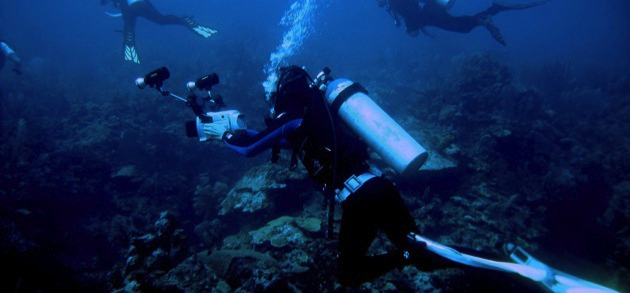
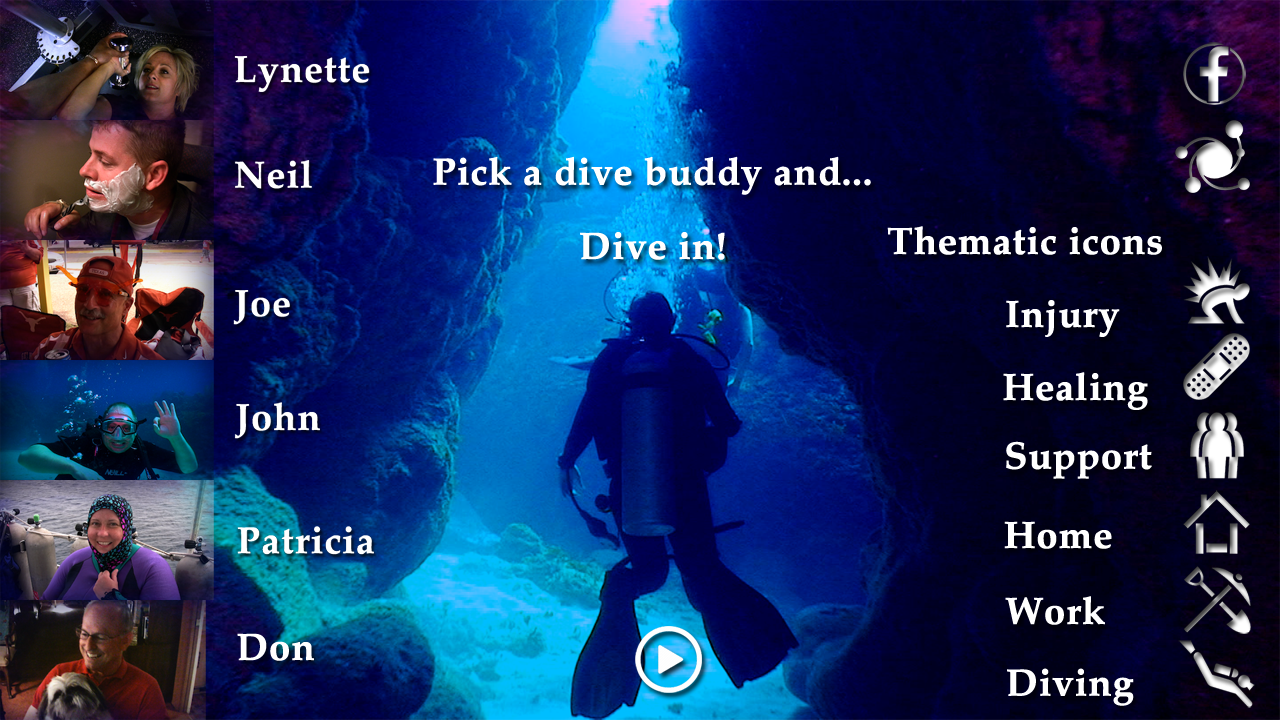

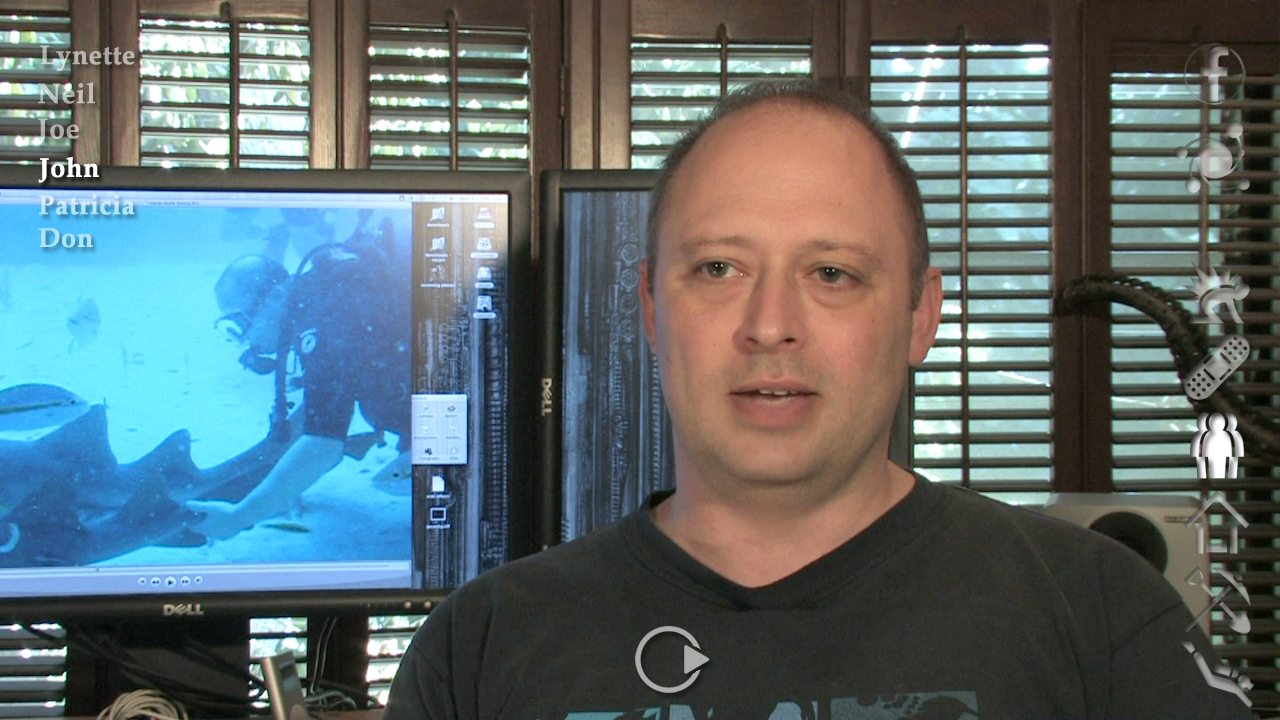
Reflections of a documentary filmmaker creating an interactive work
Reflections of a Documentary Filmmaker Creating an Interactive Work
Figure 16: Homepage of the *Texan Eels on Wheels* website. http://www.texaneelsonwheels.com/#WebOpeningMenu (photo and graphics: Gilles Tassé)
I recognize from the outset that my background as a filmmaker and documentarian influenced the development of the interactive structure of my web documentary and my aesthetic choices in graphic composition. The approach I adopted during the design and media construction of my interactive documentary object is certainly more filmic than graphic; the work's communicative potential lies largely in the videographic testimonies. This is likely due, in part, to the available audiovisual material, composed of interviews and documentation of actions and locations, but also to the nature of my career as a filmmaker, in which I have always favored a sober approach, close to *cinéma vérité*, without excessive stylistic effects.
However, even though I notice strong similarities between my approach to interactive creation and the development of my linear works, I observe a significant difference. In film production, the narrative structure is created during editing. In interactive cinema, the navigation structure is established by the interface, and the narrative takes shape afterwards, in response to the interactive gestures performed by the spect-actor. It was during the design of this welcome space and this offer of action presented on the screen that I felt both the most called upon as a creator and the most disrupted in my habits as a filmmaker.
The creation of an interface is akin to developing the structure of a story, a screenplay, or even the technical breakdown of a film—each element is designed in anticipation of and according to the narrative and informational qualities of a future work, and each element influences every other element. Even if all these stages are established with the greatest care and meticulousness, they are all subject to the two subsequent production stages, filming and especially editing, which definitively structure the work. This time, I did not have access to the ultimate stage of editing—interaction becoming the structuring act—and I could therefore not give definitive form to my communicative intentions. I had to surrender control of the narrative flow to the spect-actor, while having firmly established a series of narrative possibilities and an interface consistent with my communicative intentions.
In the same way, although I consider that my interactive object prompts a quality of reflexive presence in the spect-actor similar to that allowed by documentary cinema (rather than a predisposition to action usually found in games and multimedia experimentation), I again note an important divergence. When I had to judge and test the quality of my creative work, and I assumed the role of spect-actor, I noticed a significant difference in the attitude and posture I adopted during my experimentation (compared to that which I have during a simple viewing of a linear work). This occurred even while I was in a mode of media listening and reception (more or less passive), without having the immediate intention of performing a gesture to trigger a narrative or informational detour.
The quality of spectatorship I adopted was different. I was no longer just involved in wanting to know what happens next and understanding the information I was receiving, but I was establishing links in advance between what I had seen and what I intended to experience next. Possessing a new sense of responsibility toward the experimentation to which I submitted myself, I felt narratively, intellectually, and emotionally engaged at different degrees of temporal, narrative, or cognitive involvement. Somewhat like during a frank and animated discussion, where the quality of listening feeds the reflections and the relevance of the replies being constructed, in anticipation of their utterance and reception. I believe that this multi-level involvement will be even more marked for a spect-actor directly affected by issues related to spinal cord trauma.
I submit that the spect-actor of the interactive documentary work adopts a position similar to the posture I adopt as a filmmaker when editing a film. They must consider the media assets at their disposal and construct their own narrative and reflective structure. However, they carry out this process differently, as the form they construct evolves following the progression of their understanding of the audiovisual material they discover, and which I myself have placed at their disposal. As a creator, I therefore share with them this space for reflection on a reality and on the society from which it is extracted, thus collaborating in turn in this dialogue on the real.
I believe, therefore, that my documentary and interactive object enables and promotes this collaboration in a dialogue and reflection on the real between a creator and their spect-actor. The navigational interactivity inscribed in the work seems to participate in the evolution of the understanding of the issues observed by making the spect-actor responsible for and conscious of their media and informational experimentation. I consider that this posture offered to the spect-actor predisposes them to want to reflect on the issues to which they are exposed. This particular posture is the result of my work as a filmmaker and communicator; and the preservation of this predisposition to reflection thus becomes, in my opinion, the primary responsibility of the filmmaker creating interactive documentaries.
I also had other communication objectives when developing my object. I wanted to respond to and use to my advantage the modern viewer's propensity for exchange and communication, engaged simultaneously by different media devices. I am curious to observe this interactive characteristic of my object that I developed and built around Facebook. I will see the effectiveness of this approach through the experimentation of the work. Without this important feature, my interactive documentary would be deprived of the advantages of communication and exchange provided by the Web. It would be somewhat like older works distributed on CD-ROM or DVD, limited and less performant.
Ideally, I would have liked to study other interactive possibilities offered by the experimentation of a work on the Web, Internet connectivity, and the mobility of new media devices. I am particularly interested by geolocalization, which appears to me to be a tool for reflection and exploration of the real with great possibilities. I would also have been curious to explore the possibilities of interactive construction allowing the spect-actor to modify the audiovisual quality of the information they receive by choosing for themselves, for example, the presence of cutaway shots, voice-overs, music, text, etc. However, as limited as my object may seem, its realization required me to utilize all my technical and conceptualization abilities. In the end, my work successfully fulfilled the mandate I assigned to it: that is, to adequately support and stimulate my reflection on this new documentary form, to allow me to better understand the collaboration it requires from its creator and its spect-actor, and to offer the latter a space conducive to reflection.
Bibliography
Acland, Charles R. 2009. "Curtains, Carts and the Mobile Screen" Screen, 50.1, p. 148-166. Online. http://screen.oxfordjournals.org/content/50/1/148.full. Accessed April 25, 2015.
Arsenault, Dominic. 2013. "Qui est ‘je’? Autour de quelques stratégies vidéoludiques de design de personnage pour gérer l’actantialité ludo-narrative du joueur et son immersion fictionnelle". In Bourassa, Renée and Louise Poissant (eds.). Avatars, personnages et acteurs virtuels, p. 249-272. Quebec: Presses de l’Université du Québec.
Breschand, Jean. 2002. Le documentaire, l’autre face du cinéma. *Les petits Cahiers* series. Paris: Cahiers du cinéma.
Boal, Augusto. 1995. The Rainbow of desire. London: Routledge.
Boal, Augusto. 2002. Games for Actors and Non-Actors. Second edition, London: Routledge.
Châteauvert, Jean. 2014. "Les nouvelles plateformes de diffusion. Is the Medium the message?". In Châteauvert, Jean and Gilles Delavaud (eds.). Paper abstract, D’un écran à l’autre : les mutations du spectateur. International symposium – May 21-23, 2014 - Université Paris 8. Online.
http://www2.univ-paris8.fr/cemti/IMG/pdf/Colloque_D_un_RESUME_COMMUNICATIONS_1_Revu.pdf. Downloaded March 3, 2015.
Cubitt, Sean. 1998. Digital Aesthetics. London: SAGE Publications Ltd.
Daly, Kristen. 2010. "Cinema 3.0: The Interactive-Image". Cinema Journal, 50, Number 1, Fall 2010, p. 81-98. Austin: University of Texas Press. Online.
https://www.academia.edu/2899184/Cinema_3.0_The_Interactive-Image. Accessed April 25, 2015.
Di Crosta, Marida. 2010. Entre cinéma et jeux vidéo: l'interface-film: Métanarration et interactivité. Brussels: De Boeck.
Freeman, Mark, Eric Gould Bear and Rachel Strickland. 2000. Seamless Video Expansions. MONKEYmedia Inc. and Interval research Corporation. Online.
http://seamless.tv/telescoping/article/SE_CHI2000.pdf. Accessed April 25, 2015.
Gaudenzi, Sandra. 2013. "The Living Documentary: from representing reality to co-creating reality in digital interactive documentary". PhD thesis. London: Goldsmiths (Centre for Cultural Studies), University of London. Online. http://eprints.gold.ac.uk/7997/1/Cultural_thesis_Gaudenzi.pdf. Accessed April 25, 2015.
Gifreu, Arnau. 2011. "The Interactive Documentary. Definition Proposal and Basic Features of the Emerging Genre". In Ciastellardi Matteo, Cristina Miranda de Almeida, Carlos A. Scolari (ed.), McLuhan Galaxy Conference Proceedings, p. 354-365. Barcelona: Editorial Universidad Oberta de Catalunya. Online.
http://www.scribd.com/doc/56597302/37/Arnau-Gifreu-Castells. Accessed April 25, 2015.
Grierson, John. 1966. Grierson on Documentary. Forsyth Hardy (ed.). Los Angeles: University of California Press.
MacDougall, Robert C.. 2011. Digination: Identity, Organization, and Public Life in the Age of Small Digital Devices and Big Digital Domains. Lanham, Md.: Fairleigh Dickinson University Press.
Manovich, Lev. 2001. The Language of New Media. Cambridge: MIT Press. Also available online: http://www.manovich.net/LNM/Manovich.pdf.
Murray, Janet. 1997. Hamlet on the Holodeck. The Future of Narrative in Cyberspace. Cambridge: MIT Press.
Odin, Roger. 2000. "La question du public. Approche sémio-pragmatique". Réseaux, 2000, volume 18 n°99. pp. 49-72. Online.
http://www.persee.fr/web/revues/home/prescript/article/reso_0751-7971_2000_num_18_99_2195. Accessed April 25, 2015.
Odin, Roger. 2012. "Spectator, Film and the Mobile Phone" In Christie Ian (ed.), Audiences. Defining and Researching Screen Entertainment Reception. p. 155-169. Amsterdam: Amsterdam University Press. Online.
http://www.oapen.org/search?identifier=433954. Accessed April 25, 2015.
Odin, Roger. 2012. "Cinema and the mobile phone. A semio-pragmatic approach". In Creton, Laurent, Laurent Jullier, Raphaëlle Moine (eds.) *Le cinéma en situation. Expériences et usages du film*, Théorème 15, p. 79-88. Paris: Presse de la Sorbonne Nouvelle.
Bonnard, Martin and Viva Paci, "The webdocumentary at the crossroads of a network..." (with Martin Bonnard), in *Cahiers du CIRCAV* (Cahiers interdisciplinaires de la recherche en communication audiovisuelle), "History(s) of the Internet", p. 153-172. Lille: Université Lille III. Forthcoming. Provided by the authors.
Ryan, Marie-Laure. 2006. *Avatars of Story*. Minneapolis: University of Minnesota.
Salen, Katie and Eric Zimmerman. 2014. *Rules of Play: Game Design Fundamentals*. MIT Press.
Tassé, Gilles and Élène Tremblay. 2015. "Creation of relational spaces in the web documentary". In *Canadian Journal of Communication*. (Article). Forthcoming. Provided by the authors.
Tryon, Chuck. 2013. *On-Demand Culture: Digital Delivery and the Future of Movies*. New Brunswick, NJ: Rutgers University Press.
Whitelaw, Mitchell. 2002. *Playing Games with Reality*. Online.
http://mtchl.net/wordpress/wp-content/uploads/2014/11/Whitelaw-Playing-Games-Reality.pdf. Accessed April 25, 2015.
Weissberg, Jean-Louis. 1999. "A return to interactivity". *Revue des sciences de l'éducation*, vol. 25 (1), p. 167-199. Online. http://id.erudit.org/iderudit/031997ar. Downloaded April 25, 2015.
Filmography
Be Now Here. Michael Naimark, 1995. (immersive installation)
Drum Making. Gilles Tassé, 1996.
Heads Up. Gilles Tassé, 1995.
Portable Portraits. Rachel Strickland, 1989 – 1998. (interactive prototype)
Texan Eels on Wheels. Gilles Tassé, 2013.
Texan Eels on Wheels Interactive. Gilles Tassé, 2015. Online. http://www.texaneelsonwheels.com
List of Figures
List of Abbreviations
ARTE : Association Relative à la Télévision Européenne
BBC : British Broadcasting Corporation
CSS : Cascading Style Sheets
CD-ROM : Compact Disk - Read Only Memory
DVD : Digital Versatile Disc
U.S. : United States of America
HD : High-definition video
HTML5 : Hypertext Markup Language (version 5)
MPEG-4 AVC : Moving Picture Experts Group - Advanced Video Coding
NPR : National Public Radio
URL : Uniform Resource Locator
Web : World Wide Web
YWCA: Young Women's Christian Association
To my good friend John Turkel
“No matter where you go . . . there you are."
Liste des figures
- Fig. 1Tillie Olsen (Yonnondio, a book about the past…)chapitre-1
- Fig. 2Social workers in the television studio.chapitre-1
- Fig. 3Joe and Judy Charlo (Drum Making)chapitre-1
- Fig. 4Eels on Wheels in Belize. (Texan Eels on Wheels)chapitre-1
- Fig. 5Michael Naimark in Timbuktu during the shooting of Be Now Here.chapitre-3
- Fig. 6Physical interface of Be Now Here.chapitre-3
- Fig. 7Walter Humphries, gold prospector, Yellowknife, April 1997.chapitre-3
- Fig. 10Gilles Tassé in Belize during the shooting of Texan Eels on Wheels.chapitre-4
- Fig. 11Category icon samples for the Texan Eels on Wheels prototype.chapitre-4
- Fig. 13Home screen of the Texan Eels on Wheels interactive work.chapitre-4
- Fig. 14Star configuration of character/theme links for Texan Eels on Wheels.chapitre-4
- Fig. 15Video navigation interface — Interview John / Support.chapitre-4
- Fig. 16Home page of the Texan Eels on Wheels website.chapitre-4
Liste des sigles
- ARTE
- European Television Association
- BBC
- British Broadcasting Corporation
- CSS
- Cascading Style Sheets
- CD-ROM
- Compact Disk – Read Only Memory
- DVD
- Digital Versatile Disc
- É.-U.
- United States of America
- HD
- High-definition video
- HTML5
- Hypertext Markup Language (version 5)
- MPEG-4
- Moving Picture Experts Group – Advanced Video Coding
- NPR
- National Public Radio
- URL
- Uniform Resource Locator
- Web
- World Wide Web
- YWCA
- Young Women's Christian Association