A brief creation-based analysis of linear works
Brief analysis of the creation of linear works
Let us note that nothing compels the audience to follow the indications given by the film (even if they have identified them). Regarding the choice of the mode(s) of production of meaning, the film carries little weight in the face of the constraints of context. (Odin 2000, p. 61)
In agreement with Roger Odin, I recognize that the audiovisual object takes on multiple meanings during its experimentation by the audience. However, generally speaking and according to my experience, the documentary film is a work that is particularly determined and precise in its communicative intentions. Although filmic discourse is perceived by the audience in a manner entirely independent of the creative intentions that engendered it, its formalization is the result of choices guided by specific expectations of perception, understanding, and interpretation on the part of the filmmaker responsible for its production. According to Jean Breschand, documentarist and professor, the production constraints and aesthetic choices that give shape to the film necessarily orient the understanding of the represented reality:
It can never be said enough that however strong our belief in the fidelity of a recording may be, an image is in no way objective. It is merely the result of a set of technical constraints and representational choices. We must therefore constantly interrogate its form, that is to say, the way in which we are given to see something of the world. (Breschand 2002, p. 9)
As we shall see in this chapter, this "orientation" of the gaze cast by the spectator upon the represented reality extends to the filmmaker's apprehension and appreciation of the constraints of the film's reception context. In fact, my work as a documentarist has always required that I be able to predict, as far as possible, the conditions of reception for my films—that is, the film's presentation apparatus, as well as the spectator's reaction. The form of the audiovisual work to be created had to respond more to its particular context of reception and to the prerogatives of communicative intentions than to a desire for artistic expression or formal experimentation. Following the evolution of audiovisual media, these works were produced on various analog and then digital formats, to be subsequently broadcast on a television station, distributed as DVDs, projected on the big screen, or made available on the Internet. On each of these occasions of audiovisual production, I was always consciously engaged in a communicative process involving as much the observation of a reality as its bilateral interpretation—author/spectator. Ideally, the communicative apparatus would allow the understanding I had constructed of this documented reality to be transmitted through the document I was producing, in order to be finally and ultimately understood by the target audience during its viewing.
According to Roland Barthes, this process of global and bilateral interpretation is composed of numerous variables that contextualize the different possible understandings of the text during its reading:
We know now that a text is not a line of words releasing a single "theological" meaning (the "message" of the Author-God) but a multi-dimensional space in which a variety of writings, none of them original, blend and clash. The text is a tissue of quotations drawn from the innumerable centres of culture. (Barthes 1994, p. 493)
While the documentary object I am designing is taking an interactive form and the conditions of its viewing and experimentation are expected to be multiple and changing, it seems important to me to look back briefly at some of my previous linear works. At this point in my research, my main intention is to highlight what appears essential in the communicative process that has marked my path as a documentarist, in order to apprehend what it is to become in its next interactive incarnation, which is *a priori* less directed.
To do this, I will briefly present the communicative apparatus of four works, differing in form and substance, and highlight their ability to achieve their primary communicative intentions and to participate in the spectator's understanding of the issues presented to them.
1.1 *Yonnondio, a book about the past…* (1991)
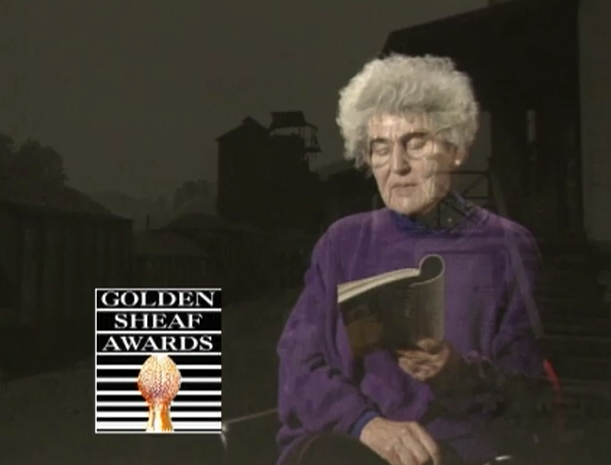
*Yonnondio, a book about the past…* (1991, Beta SP, 15 min.), my first film as producer and director, is a documentary portrait of the American writer Tillie Olsen. This feminist activist (83 years old at the time), whom I met at the Banff Centre for the Arts in Alberta, inspired me with her passion and her still-intact desire for social engagement.
Figure 1: Tillie Olsen (*Yonnondio, a book about the past…*)
I sought to produce a film illustrating Ms. Olsen’s social engagement starting from the late 1930s, in order to inspire today’s audience to pursue the demands for a more just and equitable society. Working with a limited production budget, I opted for a minimalist *mise en scène* of two significant excerpts from Tillie Olsen's first book, combined with a studio interview with the author. During editing, I prioritized the most committed moments of the interview, setting aside those that seemed too directive or potentially patronizing, and then juxtaposed them with the dramatic, emotionally charged sequences. My communicative objective was to attempt to move the spectators—who were not necessarily feminists—to encourage them to reflect on the issues of gender equality and respect. This fifteen-minute film was nominated at the Yorkton Film Festival, screened in a cinema, and followed by a lively discussion with the audience.
Three constituent elements of a reflective framework are put into action here. First, an emotion elicited and directed by the narrative discourse; then, individual or shared reflection (during a discussion); and finally, the search for additional information to pursue this reflection. In this first example of communication, the conditions of distribution play a smaller role than the qualities of the emotive discourse, both in the staging of the book excerpts and in the selected interview moments. My authorial intention was to ensure that the exchanges initiated after the screening would continue and that some spectators would leave with the desire to learn more about the social positions defended by Tillie Olsen throughout her life.
1.2 *Heads Up* (1995)
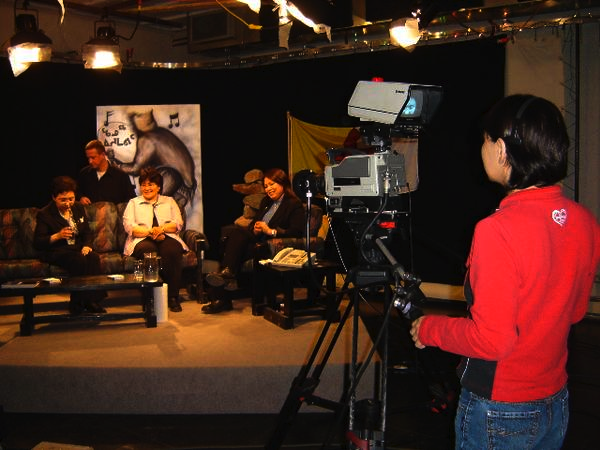
*Heads Up* (1995, Beta SP, 30 min.) illustrates another method of social communication and creation based on a targeted audience. Produced in partnership with the Status of Women department of the Northwest Territories and the Yellowknife YWCA, the film presents women's status issues concerning young Indigenous women. Broadcast on a public television channel, the film was preceded and followed by a discussion between various stakeholders from the women's status sector to introduce and elaborate on issues of self-esteem and family dysfunction. During the broadcast, the phone numbers of government agencies and social organizations appeared on the screen to allow people in difficulty to obtain the necessary support, particularly those living in remote areas far from the city of Yellowknife. As an audiovisual object for discussion and awareness-raising, the documentary was intended for an audience composed primarily of young women, to encourage them to learn about their rights and the resources available to support them in their difficulties.
Figure 2: Social workers in the television studio.
(photo: Gilles Tassé)
During the writing, production, and editing of this commissioned film, I knew that its broadcast would be preceded and followed by discussions among social workers informed about the issues illustrated. I was also aware that the document was being broadcast on the public channel during prime time and that a support network would be available to respond to any potential increase in requests for help. From the outset, I therefore took care to achieve a balance between information and awareness of the social issues exposed, taking into account the viewing conditions, which could become problematic and anxiety-inducing.
Here, therefore, the communication framework is constructed in terms of its outcome outside of its own form. The audiovisual object is in relation with other communication devices: telephone, live TV, and social workers. It acts as the catalyst for a global process of social intervention with specific aims.
1.3 *Drum Making* (1996)
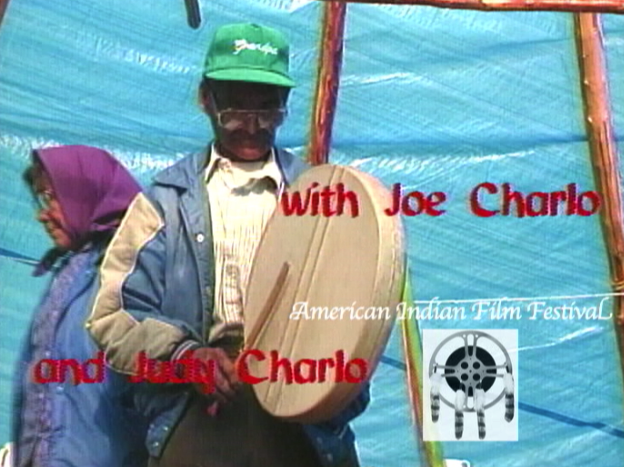
For the production of *Drum Making* (1996, Beta SP, 25 min.), I accompanied a group of teachers to a Dene First Nation fishing camp on an island in the Great Slave Lake, near Yellowknife. For several days, the group followed and recorded the teachings of Joe Charlo, an elder and traditional drum maker, and the last heir to thousand-year-old songs.
Figure 3: Joe and Judy Charlo (*Drum Making*)
(video frame, camera: Gilles Tassé)
In this case, it was a work of ethnographic documentation, the preservation of cultural identity, and the transmission of knowledge. The document was subsequently intended for viewing in secondary school classrooms across various Dene communities in the Northwest Territories, with the pedagogical support of teachers. In the style of *cinéma vérité*, I filmed without interrupting or modifying the process of explaining and manufacturing drums, along with several moments of traditional singing. On a few occasions, I noticed that Joe Charlo paused to allow me to change video cassettes or batteries, and I attempted to minimize the impact of my presence.
During editing, I was aware that the intended viewer was a Dene teenager and that the document viewed in class would be supported by an educator who could stop the viewing at any time to initiate a dialogue and answer questions. I was also conscious that the film would serve a dual purpose as a pedagogical tool for adolescents and an identity-building tool for young Dene people. I therefore wanted both to clearly illustrate each step of the instrument's fabrication and to convey the immense work undertaken by Joe Charlo and the relationship of respect and mutual aid existing between him and his wife, Judy. All this while keeping the film short enough to sustain the interest of young teenagers.
In the same manner as previous works, the film benefits from the support of resource persons and an environment that facilitates dialogue and reflection. Here, the function of the document is twofold: to preserve traditional knowledge in a precarious situation and to promote identity construction and self-esteem among Dene youth.
1.4 Texan Eels on Wheels (2013)
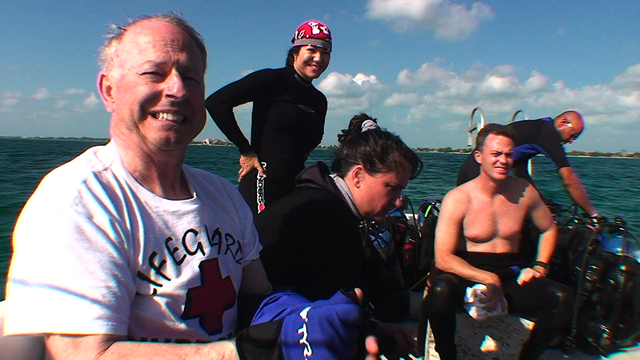
The production of the film *Texan Eels on Wheels* (2013, HDV, 85 min.) was inspired by the experience of John Turkel, a friend and colleague from Los Angeles. Disabled following cancer, he became a member of the Austin-based organization Eels on Wheels, which facilitated scuba diving for people with disabilities. Finding their approach interesting, I decided to produce a documentary presenting certain members of the group: I thus accompanied them to Bonaire and Belize.
Figure 4: Eels on Wheels in Belize. (*Texan Eels on Wheels*)
(video pictogram, camera: Gilles Tassé)
My initial project was twofold: to convey the courage of people fully engaged in their lives and society; and to inform those living with similar physical disabilities in order to offer them advice and encouragement. During editing, I wanted to achieve this dual communication objective aimed at two different target audiences.
This commission proved difficult to fulfill, as the two forms of discourse were not always as compatible as I had hoped. On one hand, the document presents us with inspiring people on vacation and magnificent landscapes, while on the other, it offers technical advice and often dry medical information through classic interviews. The film was invited to the *We Speak Here* festival, broadcast on the Internet and aimed at an audience disposed to viewing this kind of documentary with humanistic qualities. To date, the film has not received any other invitation and has not been accepted into other festivals.
This partial success allows me to address the limits of my linear documentary approach. I submit that in this final case study of social communication, linear narration was unable to respond adequately to the initial communication intentions, which were, moreover, poorly defined and too broad. It would undoubtedly have been wiser to produce a documentary on the diving trip first, and then create a second, more informative and detailed document focusing on the various daily adaptations to which the film's subjects had to submit. The possibility of producing an interactive documentary occurred later, as I was reflecting on the film's presentation at a festival available on the Internet and the various documentary forms that could be distributed there.
1.5 Communication and Reflection Apparatus
As we have just seen, linear documentaries sometimes possess a multifaceted and multitemporal communication apparatus, while the quality of spectatorship they require remains rather traditionally passive. The spectator engaged by the discourse presented to them is free to reflect on what they want when they want, but their participation is not actively required in the progression of the narrative unfolding to which they are exposed. However, the extradiegetic and variable reflexive mechanics—libraries, discussions, readings, additional viewings, etc.—prompted by these linear works resemble certain aspects of the structured and intentional reflection apparatus of the interactive film offered on the Web. I agree that these new interactive works require from their spectator an active presence of reflection and action during their actual experience. But as we will see in the next chapter, this availability or predisposition for intervention is also achieved on discussion platforms between individuals and through hyperlinks leading to other media sources. The "filmmaker" producer thus has the possibility to take this external reflection process into account in the design of the global reflection process they articulate within the very interactive object they are producing. Thus, they also become a communication organizer and a media intermediary. However, to do this, they must both renounce a part of their authority over the unfolding of the work and its experience, and support and accompany the spectator's reflective journey as it occurs either within the work or outside of it, through other apparatuses.
These final analytical elements already inform us of possible modifications in the posture of the documentarian invested in the creation of an interactive documentary, as well as that of the spectator. Sandra Gaudenzi also considers that interactivity transforms the spectator's posture:
Interactivity is seen as native, as constitutive of the digital artefact. The user is not “observing” the digital artefact, not “controlling” it, but “being transformed” by it. (Gaudenzi 2013, p. 75)
She thus allows for a less apprehensive continuation of this reflection on the role of the documentarian as a creator of interactive works who is concerned with the spectator's journey and experience. In the next chapter, I will examine the new multimedia experimentation and communication apparatuses that influence the spectator's path and the quality of their media experience. My intention is to define how these new components of spectatorship now dictate the form of new audiovisual objects and how I can use and adapt my expertise as a filmmaker and documentarian in order to contribute effectively to their production.